AI-powered reverse image search is transforming how businesses manage copyright risks. By analyzing images visually - rather than relying on text - these tools help track image origins, detect unauthorized use, and ensure compliance with copyright laws. Platforms like PicDefense.io leverage massive databases and advanced technologies to identify potential copyright issues, even for altered images. Here's what you need to know:
- What It Does: AI reverse image search scans billions of visuals to find matches or similar images, even if resized or modified.
- Why It Matters: Copyright infringement can lead to hefty fines, making compliance crucial for businesses using online images.
- Key Features:
- EXIF metadata analysis for ownership details.
- Image recognition for faces, logos, and landmarks.
- Backlink analysis to trace image origins.
- Risk scoring to prioritize copyright concerns.
- How It Helps: Tools like PicDefense.io automate website scans, flag high-risk images, and offer actionable steps to resolve issues.
This technology simplifies copyright management, helping businesses avoid legal troubles while maintaining proper image usage practices.
AI Technologies That Improve Reverse Image Search
AI has revolutionized the way businesses tackle copyright challenges, especially through the use of advanced reverse image search tools. These systems delve into image analysis far beyond what manual methods can achieve, providing a robust solution for identifying and managing copyright risks.
EXIF Metadata Analysis
Every digital image carries hidden details in its EXIF (Exchangeable Image File Format) metadata. PicDefense.io taps into this data to extract valuable insights, such as camera settings, timestamps, and embedded ownership information. This step is essential for verifying image ownership and assessing potential copyright risks. Afterward, the system uses image recognition to identify specific elements that could influence copyright status.
Image Recognition: Faces, Logos, and Landmarks
AI-based image recognition goes beyond simple image matching by detecting key elements like faces, logos, and landmarks. Identifying faces can raise privacy concerns, while spotting logos and landmarks often uncovers trademark or licensing issues. This capability is particularly useful for content creators and e-commerce businesses, as it scans vast image libraries quickly to flag potential legal risks. Once these elements are identified, neural networks refine the matching process for even greater accuracy.
Similarity Matching and Neural Networks
Neural networks play a critical role in spotting altered images by learning visual patterns from massive datasets. This technology can recognize copyrighted images even if they’ve been resized, cropped, or otherwise manipulated. As explained by PicDefense.io:
"Our system meticulously searches through billions of indexed web images, including analyzing modified or manipulated images for a more accurate match."
This ensures a thorough and precise search, no matter how an image has been changed.
Backlink Analysis for Source Tracing
In addition to similarity matching, backlink analysis helps trace the origins of images across the web. PicDefense.io uses this approach to verify backlinks, track where images appear online, and identify stock image sources. This process guides users in securing proper image rights [1]. By mapping out all locations where an image is used, businesses gain a clear understanding of its distribution and origin.
Together, these AI-driven tools form a comprehensive system for copyright protection. By automating complex tasks like image analysis and tracking, businesses can stay ahead of copyright issues and reduce the risk of costly legal disputes.
How AI Simplifies Copyright Risk Assessment and Reduction
AI doesn’t just identify copyright issues - it turns those insights into practical steps businesses can take to address them. Today’s AI-powered platforms make the entire process - from spotting risks to reducing them - far easier, even for companies managing thousands of images. This seamless flow builds on the advanced detection methods discussed earlier.
Full-Site Image Scanning and Inventory Creation
AI systems can scan entire websites to create a detailed inventory of every image used. Tools like PicDefense.io use their vast databases to compare and catalog images across all parts of a site, from blog posts to product pages and marketing materials. For businesses juggling multiple websites, this feature provides a centralized overview of image usage. Plus, with ongoing monitoring, these platforms can catch new images added weekly, ensuring potential copyright issues are flagged as soon as they arise.
Identifying Potential Copyright Risks
Once an image inventory is created, AI dives deeper to assess each image for potential copyright risks. This involves analyzing various data points, such as extracting EXIF data to uncover copyright details and using automated keyword tagging for better organization. Advanced detection features identify elements that might pose legal challenges, including images likely sourced from stock photo libraries. Even if images have been resized, cropped, or altered, the system can detect duplicates or transformations, ensuring nothing slips through the cracks.
Risk Scoring and Priority Setting
After identifying risk factors, AI assigns a risk score to each image, summarizing the likelihood of copyright infringement based on the detected issues[1]. This scoring system helps businesses prioritize their efforts, focusing first on high-risk images while addressing lower-risk ones as resources allow.
Automated and Manual Workflows for Businesses
AI platforms are designed to support both automated and manual workflows, catering to businesses with varying needs. For high-volume operations, automation can process thousands of images in a short time. Meanwhile, manual workflows allow for a closer examination of individual cases. Features like backlink analysis help trace the origins of flagged images, offering guidance on where rights can be obtained and tracking where images are used.
These platforms provide clear, actionable recommendations. As PicDefense.io explains:
"Receive a clear report that combines transparency with actionable guidance."[1]
For flagged images, users can confirm their sources through reverse search results, metadata checks, and stock image detection tools. Licensed images can be whitelisted and annotated, preventing them from being flagged again in the future. Keeping thorough records of image licenses and sources not only simplifies dispute resolution but also turns copyright management into an organized, defensible process, saving businesses from chaotic last-minute scrambles.
Legal Compliance Strategies for U.S. Businesses
Navigating copyright laws can feel overwhelming, especially for U.S. businesses using images online. Missteps in this area can be costly, but with the right strategies, staying compliant becomes a routine part of your workflow. By adopting clear practices, businesses can manage these legal requirements effectively.
Best Practices for Using Images Legally
Using royalty-free images doesn't mean you're free to use them however you like. These images still come with licensing terms that must be followed [1].
Always double-check the licensing terms for every image, whether it's from a stock library or labeled as public domain [1]. Attribution, while polite, doesn't grant legal usage rights. If you don't secure proper permissions, your business could still face copyright claims [1].
Beyond copyright, there are other legal considerations to keep in mind. For example:
- Trademark laws protect logos and brand names.
- Privacy rights safeguard the identities of recognizable individuals.
- Publicity rights govern the commercial use of someone's likeness.
Images featuring people, landmarks, or private property often require additional permissions or releases for commercial use [1]. When in doubt, always seek explicit permission to avoid legal complications [1].
Why Documentation Is Important
Following best practices is just the first step - keeping detailed documentation is equally important. Maintaining records of licenses, receipts, and sources can protect your business in case of a copyright dispute [1]. Without proper documentation, proving your right to use an image becomes much harder.
For every image on your website, maintain a record of where and when you obtained its license. Creating a detailed inventory of your site's images, along with their licensing information, helps you track compliance effectively [1]. Additionally, EXIF metadata embedded in image files can provide useful details like copyright information, creation dates, and camera data, offering another layer of proof [1].
"Best practice: Keep a record of your licenses and source details for every image you use." [1]
To streamline this process, store all license details in a centralized system. This ensures that each image has corresponding documentation, making it easier to respond to copyright claims if they arise.
"Keeping documentation helps you respond quickly if you ever receive a copyright claim." [1]
Making Compliance a Business Priority
Once best practices and documentation are in place, prioritizing compliance becomes essential to avoid legal risks. Proactive measures can save your business from costly legal issues. Address potential risks immediately - if an image is flagged as potentially copyrighted and you lack the proper permissions, replace it, remove it, or secure the necessary license right away [1].
To prevent recurring issues, verify licenses and whitelist approved images with notes for future reference [1]. Integrating license verification into your content creation process ensures that compliance becomes second nature, much like proofreading or fact-checking.
Investing in compliance tools and systems is a smart move. A single copyright infringement case can lead to hefty legal fees, but tools like PicDefense.io offer a cost-effective way to manage these risks.
"PicDefense.io offers more than risk assessment; it's a comprehensive toolkit for achieving and showcasing image copyright compliance." [1]
These tools streamline license verification and make compliance checks a seamless part of your workflow [1]. Staying informed about updates to copyright laws and industry standards is also crucial. Regularly reviewing your image usage and licensing practices ensures that your business remains compliant as regulations evolve.
sbb-itb-59d21f2
PicDefense.io: An AI-Powered Solution for Copyright Management
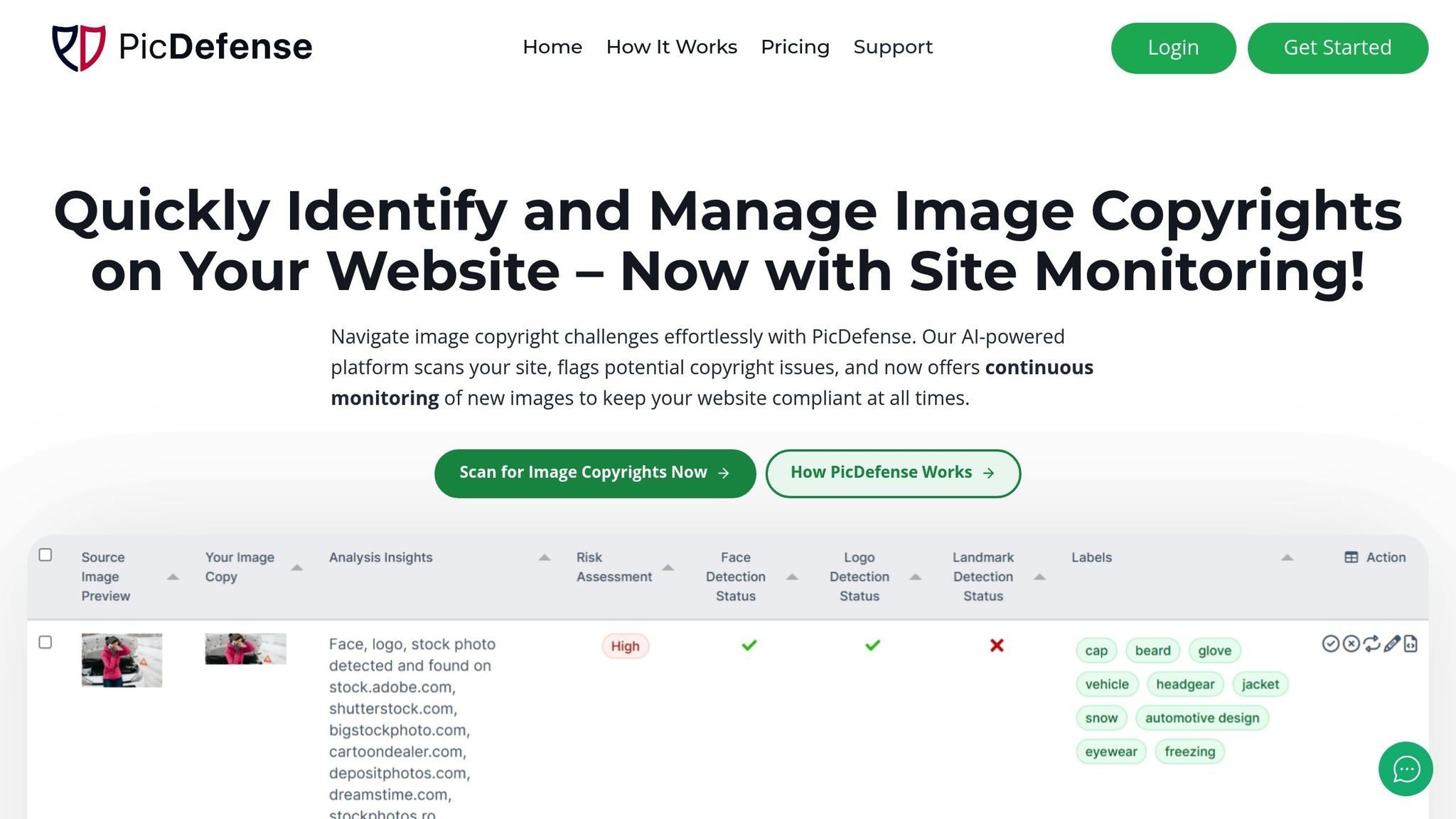
PicDefense.io simplifies the process of managing image copyrights for small and mid-sized businesses. Instead of waiting to deal with copyright claims when they arise, this platform takes a proactive approach. It addresses potential claims - even in cases where businesses may have lost track of license details - helping avoid costly demands that can range from $3,000 to $150,000 per image.
Key Features of PicDefense.io
At its core, PicDefense.io uses AI to scan entire websites and create a detailed inventory of all images. For smaller sites with fewer than 100 images, this process takes about 15 minutes. Medium-sized sites with up to 1,000 images are scanned in roughly 30 minutes [1].
The platform’s standout feature is its AI-driven risk analysis. By tapping into an extensive image database, it identifies potential copyright concerns - even for images that have been resized, cropped, or altered [1]. It examines EXIF metadata, detects faces, logos, and landmarks, and performs reverse image searches using tools like TinEye and Google Vision.
PicDefense.io also conducts backlink analysis to trace the origins of images, helping verify licenses and avoid incorrect assumptions. This feature not only prevents unnecessary risks but also provides leads for confirming image usage rights.
The Smart Rules feature automates time-consuming compliance tasks. You can create workflows to whitelist approved images, flag high-risk content, or trigger specific actions based on risk scores. This automation ensures consistent compliance while saving hours of manual work.
With its PicRisk rating system, the platform simplifies decision-making by converting technical analysis into easy-to-understand risk scores. These actionable insights help you address issues quickly and effectively.
How PicDefense.io Makes Compliance Easier
PicDefense.io centralizes all your license records in one place. You can upload receipts, store licenses, and document attribution details for every image.
One standout feature is purchase date tracking, which becomes crucial when defending against copyright claims. Copyright trolls often use archive.org timestamps to challenge ownership, but with documented purchase dates, you can prove you had the proper rights before using an image. This simple step can mean the difference between dismissing a claim and paying a hefty settlement.
The Site Monitoring feature scans your websites weekly for new images [1]. This ensures compliance remains intact as your team adds fresh content. For businesses that frequently update their sites, this automated monitoring provides ongoing protection without requiring constant manual checks.
When high-risk images are flagged, the platform suggests alternative copyright-free options from sources like Pexels. This allows you to quickly replace problematic content without compromising the visual quality of your site.
PicDefense.io also integrates seamlessly into existing workflows. With a WordPress plugin, you can directly connect your site, while API access via Zapier and Make.com enables custom automations. These integrations are particularly useful for web agencies managing multiple client websites, making it easier to scale compliance efforts.
Pricing Plans and Benefits
PicDefense.io offers flexible pricing to suit a range of business needs, with no long-term commitments required. The one-time scan credits option lets you pay based on usage, starting at $20 for 100 images ($0.20 per image) and going up to $7,000 for 100,000 images ($0.07 per image).
For ongoing protection, the platform provides monthly Site Monitoring plans:
| Plan | Monthly Cost | Sites Included | Images Included | Extra Image Cost |
|---|---|---|---|---|
| Starter | $30 | 3 sites | 150 images | $0.15 each |
| Pro | $75 | 8 sites | 500 images | $0.14 each |
| Agency | $150 | 20 sites | 1,200 images | $0.13 each |
The Pro plan offers a great balance of capacity and cost for growing businesses, while the Agency plan is ideal for web development and marketing agencies managing multiple clients. With options for both one-time scans and monthly monitoring, PicDefense.io turns copyright compliance into a predictable and manageable part of your business operations, helping safeguard your company’s future.
Using AI for Copyright Protection
The move toward AI-powered copyright protection is reshaping how businesses handle image compliance. Instead of waiting for costly copyright disputes to arise, companies are now taking a proactive stance - identifying and addressing potential issues before they escalate.
Key Steps for Copyright Compliance
With advanced detection tools at your disposal, these steps can help ensure compliance:
- Start with thorough scanning. PicDefense.io’s AI technology scans your entire website, comparing it against a database of over 73 billion indexed images[1]. This isn’t just about finding exact matches - it can also detect images that have been cropped, altered, or color-adjusted.
- Keep detailed records. Use PicDefense.io's documentation system to store purchase receipts, track acquisition dates, and log attributions. This kind of organized record-keeping is crucial if you ever need to defend your ownership rights.
- Monitor continuously. Automated weekly scans from PicDefense.io check for new uploads, reducing the risk of unintentionally using images that could lead to legal trouble down the line.
- Address flagged content quickly. The PicRisk scoring system simplifies complex analyses into actionable steps, helping you prioritize high-risk images. For flagged images, verify licensing through backlink checks or replace them if necessary.
- Leverage automation. Smart Rules let you automate key processes, like whitelisting verified images, flagging risky content, and triggering actions based on risk scores. This automation not only ensures consistent protection but also frees your team to focus on other priorities.
The Future of AI in Copyright Management
As AI tools become essential in copyright management, their capabilities continue to grow. Machine learning algorithms are now able to detect even subtle image modifications and trace intricate ownership histories. Looking ahead, we might see advancements like predictive analytics, seamless integration with stock photo platforms for instant license verification, and better tools for analyzing fair use cases - making compliance even easier.
"No tool can guarantee 100% accuracy because copyright depends on licensing rights, permissions, and context. A flagged image isn't always copyrighted, and an unflagged image isn't always safe."
- PicDefense.io [1]
This shift toward AI-driven copyright management represents a move from reactive damage control to proactive prevention. By adopting these tools, companies can build compliant and sustainable digital practices, setting the stage for long-term growth and success.
FAQs
How can AI reverse image search help businesses protect against copyright infringement?
AI-driven reverse image search tools are transforming how businesses handle copyright issues. These tools automatically scan website images, analyzing elements such as EXIF metadata, faces, logos, and landmarks. They also track where images appear online and pinpoint their original sources.
By offering features like backlink analysis to trace image origins and suggesting copyright-compliant alternatives, these tools provide practical solutions to minimize legal risks. This approach helps businesses stay on top of image copyright management, making it easier to avoid potential penalties while ensuring responsible use of visual content.
How does EXIF metadata help in verifying image ownership and identifying copyright risks?
EXIF metadata holds a treasure trove of details about an image, including when it was captured, the camera settings used, and sometimes even copyright information. By examining this data, you can trace the image’s origins and confirm who owns it.
It’s also a handy tool for spotting potential copyright issues. Embedded details like creator names or licensing terms can provide crucial information to help ensure everything stays above board.
How can businesses use AI tools like PicDefense.io to simplify copyright compliance?
Businesses can effortlessly incorporate AI tools like PicDefense.io into their operations to simplify copyright compliance. PicDefense.io provides a WordPress plugin for smooth website integration, along with API access to build custom workflows that align with unique business requirements.
To take automation a step further, PicDefense.io connects with platforms such as Zapier and Make.com, making it easy to embed into broader digital ecosystems. These integrations help businesses maintain compliance, save time, and minimize potential legal challenges.
Protect your website from image copyright claims
PicDefense scans your entire website, identifies image risks, and stores proof of compliance — so you never get caught off guard.