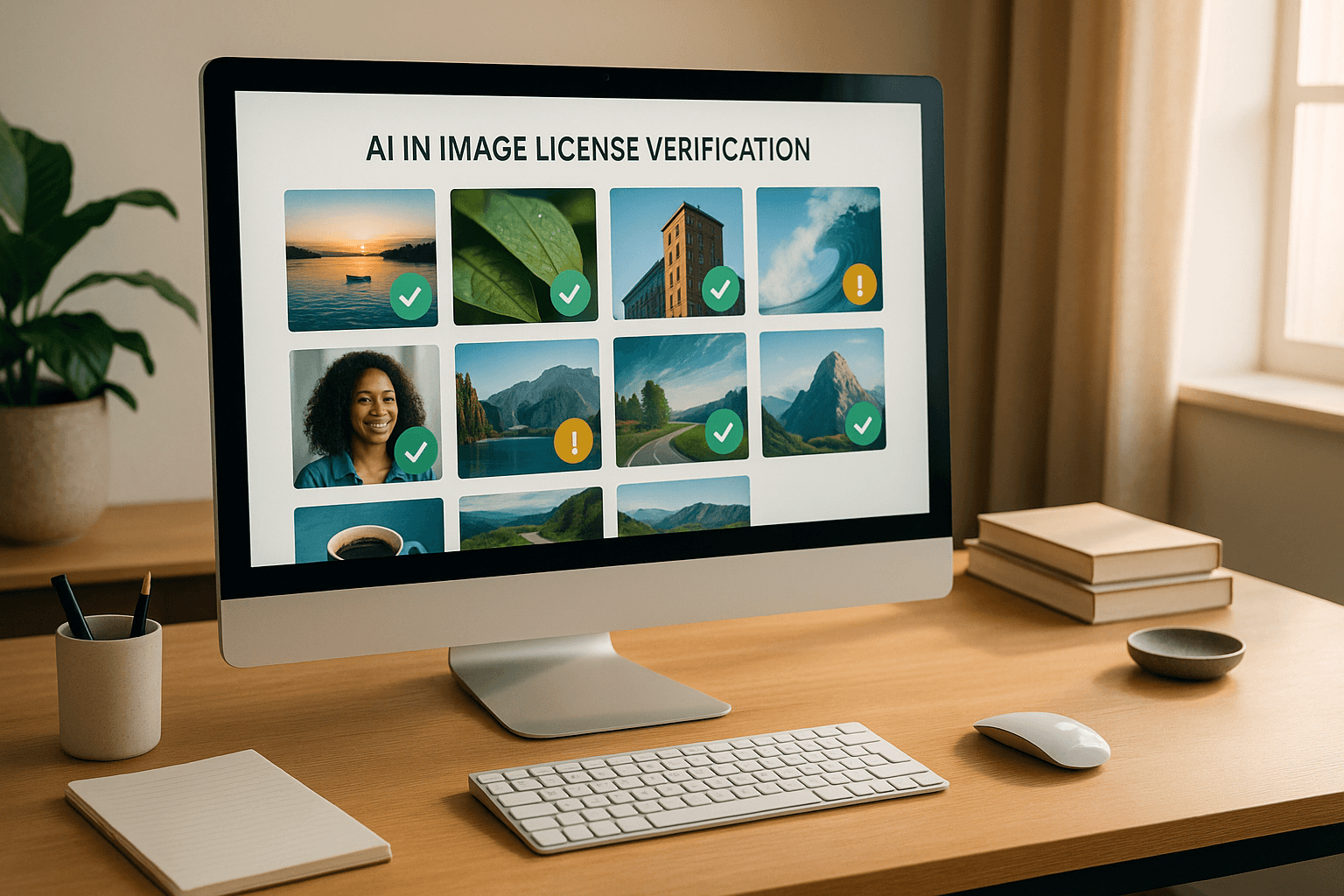
Managing image licenses just got easier with AI. Here’s why:
- Manual methods are slow, error-prone, and struggle with large datasets.
- AI tools, like PicDefense.io, automate license checks, ensuring speed, accuracy, and scalability.
- AI can process thousands of images, analyze metadata, and flag copyright issues faster than humans.
- Costly errors, like copyright infringements, are reduced significantly with AI-driven risk management.
Key Comparison:
| Feature | Manual Methods | AI-Powered Solutions (e.g., PicDefense.io) |
|---|---|---|
| Speed | Slow, time-intensive | Fast, automated |
| Accuracy | Prone to human error | Consistent, precise |
| Scalability | Limited with high volumes | Processes thousands of images seamlessly |
| Cost Structure | Labor-intensive over time | Higher upfront, lower long-term |
| Risk Mitigation | Inconsistent | Comprehensive with detailed compliance |
If you manage large image libraries or worry about copyright risks, AI tools are no longer optional - they’re essential.
AI, Verification, FactChecking, Copyright and Media Law
1. Manual Methods
Manual image license verification involves checking each image one by one to ensure proper licensing. This traditional approach starts with creating a complete inventory of all images on a website - reviewing every page, blog post, and section. From there, website owners use tools like Google Vision API or TinEye to trace the source of each image. Once the source is identified, the next step is to verify the licensing or permissions, often by examining the EXIF data embedded in the images, which may contain copyright details.
Accuracy
Manual methods often struggle with accuracy due to the complexity of copyright laws and human error. Mistakes are common, with studies showing issues like underreading (42%), cognitive biases such as satisfaction search (22%), and faulty reasoning (9%) affecting outcomes [1][3]. Reviewers can also be influenced by prior assumptions, leading to misinterpretation of copyright details [1]. Common licensing errors include overlooking territorial restrictions, failing to verify renewal clauses, or misunderstanding the scope of usage rights [2]. These inaccuracies not only slow the process but also increase the risk of compliance issues.
Efficiency
For websites with large image libraries, manual verification is a slow and labor-intensive process. Each image requires individual review, source tracking, license validation, and documentation. This level of effort can delay content updates and disrupt workflows, especially under tight deadlines. The larger the image collection, the more impractical this approach becomes, making manual methods unsuitable for fast-paced environments.
Scalability
Scaling manual verification to handle growing image collections is a significant challenge. As websites expand their visual content, the workload increases exponentially. Unlike automated systems that can process thousands of images quickly, manual methods are limited by human capacity and working hours. This limitation not only slows down operations but also increases the likelihood of errors. The financial impact can be severe - fraud and licensing oversights can cost businesses up to 5% of their annual revenue [4].
Risk Mitigation
Although manual methods allow for human judgment in complex cases, they come with inherent risks. High error rates mean unlicensed images can easily be overlooked, exposing businesses to copyright infringement claims. Additionally, manual processes lack real-time monitoring, leaving websites vulnerable to future compliance issues. Inconsistent documentation further complicates the ability to track licensing history or prove due diligence in legal situations, making manual verification a risky and inefficient choice for long-term use.
2. AI-Powered Solutions (e.g., PicDefense.io)

PicDefense.io simplifies the process of image license verification, handling everything from building an inventory to generating compliance reports. It processes thousands of images with precision, eliminating the risk of human error. By analyzing EXIF metadata, identifying key features, and conducting reverse image searches, the platform tracks where images are used online. This automated approach boosts accuracy, speeds up workflows, and scales effortlessly.
Accuracy
AI-driven tools excel at analyzing large datasets with precision. Platforms like PicDefense.io dive deep into image-specific details, such as EXIF metadata and reverse image searches, to uncover copyright indicators that manual reviews might miss. This level of detail ensures that even subtle copyright issues are identified, providing a more reliable solution for image management.
Efficiency
AI-powered platforms bring massive efficiency gains, especially for organizations managing extensive image libraries. These systems handle visual data at scale with minimal human intervention, cutting costs while increasing productivity. For example, in March 2025, PrajnaAI reported an 80% reduction in manual workload for document processing, enabling thousands of files to be handled within minutes [5].
PicDefense.io is designed to streamline both manual and automated workflows. Whether it’s analyzing a single image URL or performing bulk scans, the platform ensures a smooth process. Its continuous monitoring also helps detect fraud, security breaches, and compliance issues early, preventing larger problems down the line [6].
Scalability
One of the standout features of AI systems like PicDefense.io is their ability to scale effortlessly. By leveraging additional computational power, these platforms can process more images as needed. Integration with tools like WordPress, Zapier, and Make.com further simplifies scaling operations without requiring extra staff. According to McKinsey and Company, at least 5% of organizations’ EBIT in 2021 was attributed to AI [6], highlighting the financial benefits of such scalable solutions. Whether you're running a blog or managing an e-commerce site, these systems handle increasing image volumes without slowing down.
Risk Mitigation
PicDefense.io goes beyond accuracy and efficiency to offer robust risk management tools. Its AI-driven features identify potential copyright infringements, assess originality, and provide similarity scoring and comparative analysis [9]. Considering that willful copyright infringement can lead to penalties of up to $150,000 per instance [7], thorough and consistent analysis is essential for avoiding costly legal consequences.
The platform also suggests alternative images and uses blockchain technology to create transparent audit trails, ensuring comprehensive risk mitigation. With features like detailed compliance reports and PicRisk scores, users gain actionable insights to address copyright challenges. As the generative AI market is projected to hit $207 billion by 2030 [8], the need for advanced copyright verification will only grow, making tools like PicDefense.io indispensable for long-term risk management.
sbb-itb-59d21f2
Advantages and Disadvantages
When it comes to verifying image licenses, both manual methods and AI-powered tools bring their own strengths and challenges. Deciding between these approaches often depends on the specific needs and scale of an organization.
Manual verification relies on human judgment, which can be incredibly useful in situations where licensing details are ambiguous or require a nuanced understanding. For example, a human reviewer might better interpret the context behind a specific licensing agreement. However, this process tends to be slow and prone to mistakes - especially when dealing with a large number of images. In fact, studies show that 20% to 35% of manuscripts face image-related issues [12], highlighting how difficult it is to maintain accuracy with manual reviews alone.
On the other hand, AI-powered solutions, like PicDefense.io, tackle many of these limitations through automation and advanced technology. These tools can process images much faster, often delivering results 40% quicker and reducing document fraud by 85% [10]. Such efficiency makes them particularly attractive for organizations handling high volumes of images.
That said, AI systems aren't perfect. They can produce false positives or reflect biases if the training data isn't diverse enough. Dr. Dror Kolodkin-Gal, co-founder of Proofig, emphasizes this point:
"AI has many capabilities and will continue to improve, but we cannot rely on technology to act ethically of its own accord" [12].
Additionally, AI tools may struggle with complex licensing scenarios where human discretion is critical for interpreting context.
Cost is another key factor. While manual methods might seem cheaper at first, ongoing labor expenses can add up quickly, often surpassing the initial investment required for AI tools. For perspective, identity fraud has cost U.S. businesses nearly $17 billion [11], underlining the importance of efficient and reliable verification methods.
| Feature | Manual Methods | AI-Powered Solutions (e.g., PicDefense.io) |
|---|---|---|
| Speed | Slow and time-intensive | Fast, automated processing |
| Accuracy | Prone to human error | Consistent and precise |
| Scalability | Limited with high volumes | Easily scales to thousands of images |
| Cost Structure | Lower upfront, higher over time | Higher upfront, lower ongoing costs |
| Error Rate | High, especially with volume | Low, thanks to systematic analysis |
| Contextual Understanding | Strong human input | Limited in complex cases |
| Risk Mitigation | Inconsistent, depends on expertise | Comprehensive with compliance reports |
Ultimately, the decision between manual and AI-powered verification boils down to the organization's specific needs. For smaller operations, manual methods may suffice. However, businesses managing large image libraries can benefit significantly from AI solutions like PicDefense.io, which offer speed, consistency, and scalability. This comparison underscores the importance of aligning technology choices with operational goals to streamline copyright compliance effectively.
Conclusion
AI has revolutionized image license verification by turning what was once a slow, error-prone manual process into a fast, precise, and scalable solution. By automating tasks that traditionally took hours or even days, AI eliminates common challenges like speed limitations, human error, and the difficulty of managing large volumes of images.
The data speaks for itself. In 2023, while 91% of companies invested in AI, only 22% managed to scale it effectively [13]. This underscores the need for robust AI platforms that deliver on their promises. Take PicDefense.io as an example - it achieves over 90% accuracy in document extraction [15], making it a trusted option for businesses tackling copyright compliance. Unlike traditional methods that rely on rigid rules, AI-powered image processing learns and evolves, improving its ability to identify copyright issues over time [15].
For small and mid-sized businesses, which often face the same legal risks as larger firms but with fewer resources, AI offers a practical path to enterprise-level copyright protection. With the generative AI market projected to hit $207 billion by 2030, growing at a compound annual rate of 24.40% [8], adopting AI-driven copyright solutions isn't just a good move - it’s a necessary one.
Success in this area depends on selecting trustworthy AI platforms with clear licensing agreements that outline ownership, usage rights, and any restrictions on commercial use. Staying updated on copyright law changes in your region is equally important to avoid legal complications [14]. Together, these steps provide a strong foundation for businesses to safeguard their operations.
For companies managing more than a few dozen images, AI-powered tools like PicDefense.io are no longer optional - they’re essential. These solutions combine speed, accuracy, scalability, and cost-efficiency, making them indispensable for modern copyright compliance. While manual methods might still suffice for very small operations or niche cases, the future lies in AI-driven verification. These systems not only adapt and improve over time but also offer businesses the protection they need in today’s complex digital environment.
The real question isn’t whether AI will take over image license verification - it’s whether your business will adopt these tools before copyright issues turn into costly setbacks.
FAQs
How does AI make image license verification more accurate than manual methods?
AI has transformed the way image license verification is handled, offering a faster and more reliable alternative to traditional methods. By automating complex processes, it reduces the likelihood of human error and can efficiently sift through massive datasets, such as image metadata and licensing agreements, to ensure compliance with copyright laws. This eliminates the time-consuming and error-prone nature of manual checks.
What sets AI apart is its ability to use advanced recognition technology to accurately match images with their proper licenses. Over time, these systems become even more dependable as they process more data and refine their capabilities. This not only speeds up the identification of potential copyright issues but also simplifies the verification process, helping businesses avoid legal complications and operate with greater confidence.
What challenges and risks come with using AI alone for image license verification?
AI undoubtedly brings a lot to the table when it comes to image license verification, but relying on it entirely isn't without its hurdles. For instance, AI systems can sometimes misread or miss subtle copyright details, particularly in tricky legal situations or when licensing terms aren't crystal clear. There's also the issue of AI-generated images unintentionally resembling existing copyrighted works, which could spark infringement concerns.
Another challenge lies in the shifting legal landscape surrounding AI-generated content. Questions about who owns and has the rights to license such content are still up in the air, creating potential gray areas and disputes. To navigate these complexities effectively, pairing AI tools with human judgment and expertise is essential for maintaining accuracy and compliance.
Why is AI critical for businesses managing large image libraries, especially in terms of cost and scalability?
AI has become a game-changer for businesses managing large image libraries, simplifying workflows, cutting costs, and making growth more manageable. By automating tasks such as spotting copyright risks, analyzing image metadata, and tracking the origins of images, AI takes over what would otherwise be tedious, time-consuming manual work. This not only saves time but also reduces labor expenses.
What’s more, AI systems can easily scale to accommodate expanding image collections without requiring a matching increase in resources. This allows companies to grow their operations while staying efficient and compliant, keeping the management of digital assets both smooth and budget-friendly.
Protect your website from image copyright claims
PicDefense scans your entire website, identifies image risks, and stores proof of compliance — so you never get caught off guard.