AI-driven watermarking has transformed how digital images are protected. Unlike older watermarking methods that can be easily removed or degrade image quality, AI embeds watermarks directly into an image's structure, making them nearly invisible and highly resistant to tampering.
Key Points:
- Invisible and Secure: AI embeds watermarks into textured areas of an image, preserving quality while ensuring they’re difficult to remove.
- Resistant to Edits: These watermarks survive compression, cropping, rotation, and even advanced AI regeneration attacks.
- High Quality: Metrics like PSNR (~51) and SSIM (~0.998) show minimal impact on image clarity.
- Advanced Detection: AI can verify watermarks even after significant alterations, ensuring copyright protection.
- Efficient Solutions: Tools like InvisMark and WaterFlow make embedding faster and more reliable.
This new approach not only secures digital content but also aligns with upcoming regulations like the EU AI Act, which will require machine-readable markings for AI-generated images. AI watermarking is already reshaping how businesses safeguard their visual assets and avoid the hidden costs of ignoring image copyright.
How AI Generates Adaptive Watermarks
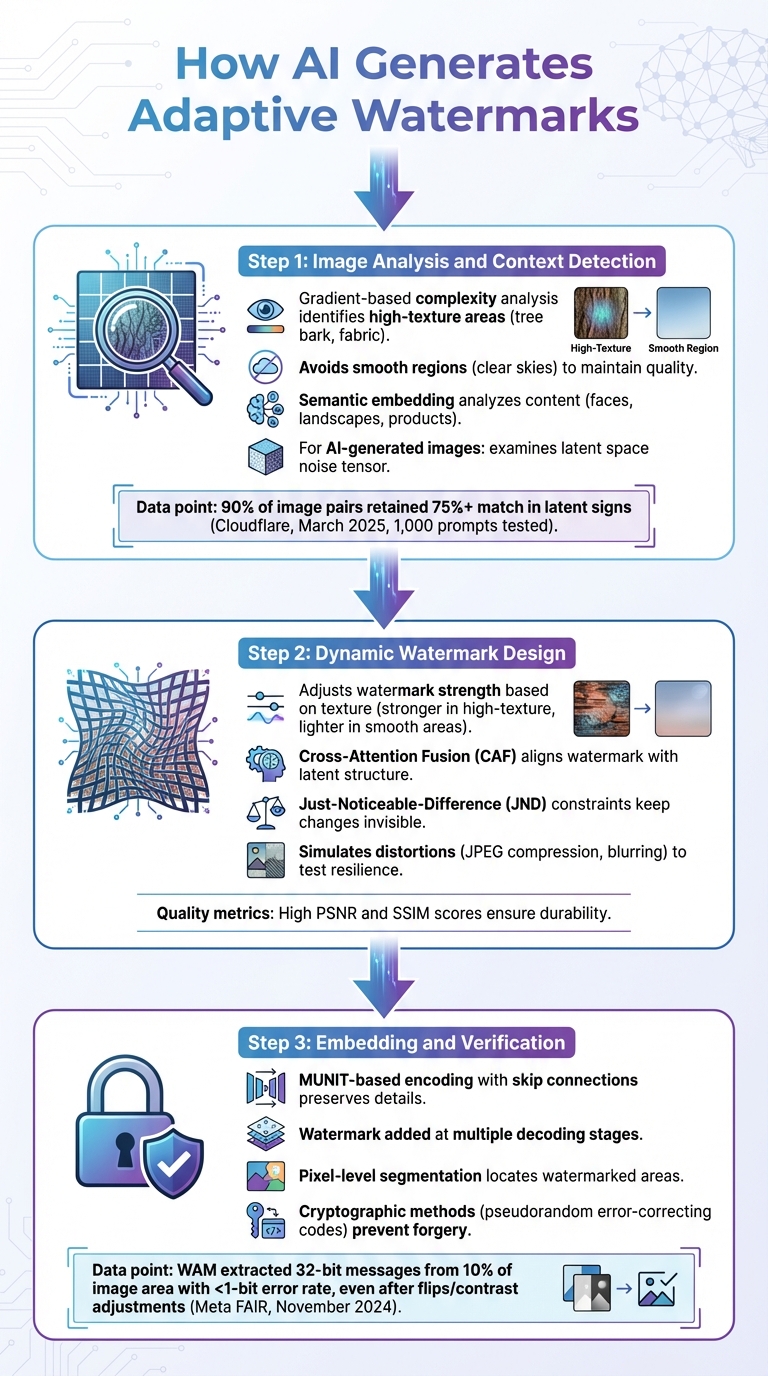
How AI Creates Adaptive Watermarks: 3-Step Process
AI uses a structured, three-step process to create adaptive watermarks that blend seamlessly into images while resisting tampering. To protect your website from image copyright infringement, understanding these technical safeguards is essential. Here's how it works:
Step 1: Image Analysis and Context Detection
Before embedding a watermark, AI analyzes the image to determine the best placement. Using gradient-based complexity analysis, the system identifies areas with high texture detail, like tree bark or fabric patterns, which are ideal for embedding. Smooth regions, such as clear skies, are avoided to maintain the image's visual quality [8].
"The watermark embedding should focus on complex regions while avoiding smooth areas to ensure high visual quality of the watermarked image." - ARIW-Framework [8]
Some systems take this a step further with semantic embedding frameworks, analyzing the image's content - whether it's a face, landscape, or product - to design watermarks based on the subject rather than just pixel data [5]. For AI-generated images, such as those created by Stable Diffusion, the system examines the latent space (the noise tensor before rendering) and adjusts watermark placement by modifying specific values in this space [9].
In March 2025, Cloudflare researchers tested this approach with 1,000 prompts from the PartiPrompts benchmark dataset. Using DDIM Inversion on Stable Diffusion 2.1 images, they found that 90% of image pairs retained at least a 75% match in latent signs, proving that watermarks can be reliably recovered by reversing the image generation process [9].
Once the context is analyzed, the AI customizes the watermark design to suit the image.
Step 2: Dynamic Watermark Design
After analyzing the image, the system creates a watermark tailored to its content. Instead of applying a fixed pattern, AI adjusts the watermark's strength based on texture. High-texture areas receive stronger signals, while smooth regions get lighter ones to maintain visual quality [8].
Advanced systems use Cross-Attention Fusion (CAF) modules to align the watermark with the image's latent structure [10]. To keep the watermark invisible, Just-Noticeable-Difference (JND) constraints are applied, ensuring that pixel-level changes stay below what the human eye can detect [10]. The system also simulates real-world distortions, like JPEG compression or blurring, to test the watermark's resilience and calculate robustness weights before embedding [8].
Studies show these techniques achieve high Peak Signal-to-Noise Ratio (PSNR) and Structural Similarity Index (SSIM) scores, ensuring both image quality and watermark durability [1].
Step 3: Embedding and Verification
The final step is embedding the watermark and ensuring it can be reliably detected later. AI systems often use MUNIT-based encoding with skip connections, which preserve fine image details while embedding subtle watermark residuals [1]. For diffusion models, the watermark is added at multiple decoding stages, evolving alongside the image's features [10].
Detection systems are designed to extract these embedded signals even after significant edits. For instance, Meta FAIR's Watermark Anything Model (WAM) can perform pixel-level segmentation to locate watermarked areas. In tests conducted in November 2024, WAM successfully extracted distinct 32-bit messages from areas covering just 10% of an image, with less than a 1-bit error rate, even after flips or contrast adjustments [6].
The most advanced systems also incorporate cryptographic methods, like pseudorandom error-correcting codes, to ensure the watermark cannot be forged or removed [9]. Because the watermark is embedded directly into the pixels - not stored in metadata - it remains intact through downloads, re-uploads, and edits, making it highly robust against tampering.
sbb-itb-59d21f2
Benefits of Adaptive Watermarks for Online Content
Adaptive watermarks tackle the persistent challenges of digital content protection with a fresh approach. By using AI to analyze and adapt to each image's unique characteristics, these watermarks provide stronger security without compromising the visual appeal of the content. Unlike older methods that apply the same watermark pattern across all images, adaptive systems tailor their approach, delivering a more effective and seamless solution.
Higher Resistance to Removal
Traditional watermarks often fail when images are cropped, compressed, or edited - common practices on platforms like social media. Adaptive watermarks, however, embed data into textured areas of an image, making them resilient to these alterations. For instance, InvisMark achieved over 97% bit accuracy even after distortions like JPEG compression at factor 50 and rotations up to 10 degrees [1]. Similarly, WAM testing confirmed over 95% bit accuracy following horizontal flips and contrast adjustments [6].
"In traditional watermarking, the watermark signal fades away and is no longer detected as the surface of the watermarked area decreases... WAM can locate watermarked areas in spliced images and extract distinct 32-bit messages from multiple small regions." - Tom Sander et al., Meta FAIR [6]
Preservation of Image Quality
A standout advantage of adaptive watermarking is its ability to maintain the original image's quality. Instead of uniformly adding noise, these systems strategically place watermark data in textured areas like fabric patterns or tree bark, where subtle changes go unnoticed by the human eye. Smooth areas, such as clear skies, are left largely untouched, avoiding visible artifacts.
Metrics back up this approach. Traditional methods typically achieve a PSNR (Peak Signal-to-Noise Ratio) near 40, while adaptive systems like InvisMark reach approximately 51 PSNR and 0.998 SSIM (Structural Similarity Index) [1]. This means the watermarked image looks almost identical to the original. For e-commerce sites and businesses showcasing products, portfolios, or brand assets, this quality retention is crucial, as it ensures their images remain visually appealing while being protected.
Improved Copyright Protection
Adaptive watermarks provide robust, pixel-level copyright protection, especially valuable for small and mid-sized businesses. Unlike metadata, which is often stripped during uploads, these watermarks remain embedded within the image itself, enabling ownership verification without additional storage or complex workflows [11]. With payload capacities of up to 256 bits, businesses can embed detailed identifiers like UUIDs and error correction codes, ensuring reliable retrieval [1].
"Properly designed invisible watermarks can survive transformations and act as a latent serial number for the work itself." - Nikhil John, InCyan [11]
Object-level watermarking offers an even more precise solution by allowing specific elements within an image - like a product or logo - to be protected, rather than the entire frame. Recent advancements in this area have achieved 99% bit accuracy while reducing model parameters by 100,000x compared to full-frame methods [12]. This makes the technology accessible to businesses with limited technical resources.
These features highlight why adaptive watermarking stands out as a superior method for protecting digital content, combining resilience, quality preservation, and advanced copyright safeguards.
Comparison: Standard vs. AI-Driven Adaptive Watermarks
Key Differences in Technique and Effectiveness
Standard watermarking techniques rely on fixed methods, such as pixel-level adjustments or frequency-domain transformations, to apply a uniform pattern across an image [1]. Detailed technical specifications for these methods are available in our technical documentation. On the other hand, AI-driven watermarking uses deep learning and latent-space techniques to embed watermarks that adapt to each image's unique features.
The performance gap between these approaches is striking. For instance, in November 2024, Microsoft Responsible AI researchers unveiled InvisMark, which achieved a peak signal-to-noise ratio (PSNR) of around 51 and a structural similarity index (SSIM) of 0.998 while encoding 256-bit watermarks into high-resolution images. By comparison, traditional methods typically reach a PSNR of about 40 and have payload capacities of less than 100 bits [1]. Later, in January 2026, Zhejiang University researchers introduced the PAI Framework, which demonstrated 99.0% detection accuracy under removal attacks and 96.3% accuracy against spoofing attacks - a 37.25% improvement over older techniques [3].
Here’s a side-by-side comparison of the key features:
| Feature | Standard Watermarking | AI-Driven Adaptive Watermarking |
|---|---|---|
| Embedding Method | Pixel-level techniques (e.g., LSB) or frequency-domain transforms (DCT/DWT) [1] | Latent-space manipulation and learned residuals |
| Visual Impact | PSNR around 40 with noticeable artifacts [1] | Near-invisible (PSNR ~51, SSIM 0.998) [1] |
| Resistance to Attacks | Vulnerable to JPEG compression, cropping, and regeneration attacks [1] | Resilient against compression, scaling, and adversarial redrawing [2] |
| Payload Capacity | Low (under 100 bits) [1] | High (up to 256 bits) [1] |
| Tamper Localization | Limited ability to detect semantic tampering [3] | Capable of identifying semantic-level tampering [3] |
To highlight the advantages of AI-driven techniques, one expert explains:
"Watermark robustness tends to increase with stronger semantic coupling between watermark signals and generated content." – Qingyu Liu et al., Zhejiang University [3]
Another major advantage of AI-driven watermarking is speed. For example, the WaterFlow method, introduced by New York University researchers in April 2025, operates 100 times faster than traditional optimization-based techniques while maintaining high robustness against complex attack combinations [2].
What sets AI-driven watermarking apart is its ability to embed signals during the image generation process. This approach makes the watermark inseparable from the content itself, effectively countering one of the biggest weaknesses of traditional methods: regeneration attacks. These attacks allow AI models to redraw images and strip away pixel-level protections, a vulnerability that AI-driven systems are designed to overcome [2] [3].
How PicDefense.io Supports Adaptive Watermarking

AI-Powered Image Analysis
PicDefense.io uses AI-driven image analysis to support adaptive watermarking by scanning websites and identifying copyright risks across all images. The platform crawls your site, catalogs every image, and compares them against a massive database of 73 billion images to flag potential copyright issues [16]. It also validates EXIF metadata and pinpoints key visual features [16].
A standout feature of this system is its ability to detect "Non-Melting Points" (NMPs). These are core semantic areas within images that remain consistent, even after alterations or visual paraphrasing attacks [13]. This makes it possible to trace whether an image has been modified or regenerated - an increasingly critical function as we near 2026, when up to 90% of online content could be synthetically generated [13]. To help prioritize actions, the platform assigns each image a PicRisk Score, guiding users on whether to replace, license, or apply adaptive watermarking [15][16]. This thorough analysis forms the backbone of effective compliance and risk management strategies.
Automated Compliance and Risk Mitigation
PicDefense.io goes beyond just embedding dynamic watermarks - it offers a full suite of tools for managing risks and protecting digital assets. When images are flagged, the system provides actionable solutions. For example, users can replace flagged content with free stock photos from Pexels, accessible through the WordPress plugin’s "Replace" button [15][16]. For images you want to keep, the platform assists in documenting proper licensing, including details like source attribution, purchase dates, and license files. This creates a solid defense against potential copyright claims.
The platform supports four integration methods, including a WordPress plugin and API access. Its Site Monitoring feature, priced at $30/month, performs weekly scans of newly uploaded images to identify unverified content before it becomes a legal issue [16]. Small scans (under 100 images) typically generate reports within 15 minutes, while medium scans (under 1,000 images) take about 30 minutes, ensuring quick compliance checks [16].
With the EU AI Act set to enforce machine-readable markings for AI-generated images starting August 2026 [4][14], PicDefense.io’s AI tools help users stay ahead of these regulations. By identifying high-risk elements and providing detailed compliance documentation, the platform simplifies the adoption of adaptive watermarking techniques. These automated solutions strengthen image protection across your entire web presence, making it easier to navigate evolving copyright and regulatory landscapes.
Conclusion
AI-powered adaptive watermarking is changing the way we protect digital images. Unlike older methods that rely on fixed patterns - easily removed by cropping or compressing - adaptive watermarks embed themselves into the image's semantic structure. This means they can withstand common manipulations like JPEG compression, rotation, and even inpainting. Modern frameworks already boast impressive results, achieving up to 98.43% verification accuracy with a PSNR of around 51, as studies have shown [1][3]. This approach not only enhances security but also ensures content integrity.
What makes adaptive watermarking stand out is its dual purpose: it verifies ownership and identifies parts of an image that have been tampered with. By coupling the watermark with the image's semantics, any significant alteration triggers the watermark to either confirm ownership or flag the tampering [3][10].
"The invisible signatures are here and working... What remains uncertain is whether technical solutions alone can address the societal questions about AI-generated content." – Sankalp Salve [7]
Adaptive watermarks also bring practical benefits beyond just copyright protection. They can store significant data, enabling persistent serial identification [1][11]. This capability is increasingly relevant as regulations like the EU AI Act require machine-readable markings for AI-generated images.
From a business perspective, these advancements directly improve risk management strategies. For instance, platforms such as PicDefense.io integrate adaptive watermarking with tools for compliance workflows. By combining watermark analysis with automated risk scoring and documentation, businesses can better handle copyright concerns and avoid disputes. This integration highlights how AI-driven watermarking is already playing a crucial role in meeting today’s rigorous compliance standards.
The industry is also moving toward embedding watermarks during the image creation process, rather than applying them afterward. This "in-generation" watermarking approach offers an extra layer of security, reflecting the ongoing evolution of digital asset protection.
FAQs
How is an adaptive watermark different from a regular watermark?
An adaptive watermark changes based on the specific properties of an image, ensuring it blends seamlessly while remaining more secure and harder to detect. On the other hand, a regular watermark relies on fixed embedding rules that don't adjust to the content, making it less flexible and potentially easier to spot.
Will AI watermarks survive cropping, compression, and AI edits?
AI-generated watermarks are built to endure typical alterations like cropping, compression, and edits. This durability is especially true for advanced embedding techniques. For instance, semantic or content-aware watermarks blend into the image's meaningful elements rather than just sitting within its pixel structure. Their strength, however, hinges on the specific embedding method used and how aggressive the edits are. Some techniques can still be weakened or even removed with sophisticated attacks.
What data can an invisible watermark actually store?
An invisible watermark can carry a large amount of information, such as 256-bit data that includes UUIDs and error correction codes. This design ensures the watermark remains readable even if the image is altered or distorted, making it a dependable option for a wide range of applications.
Protect your website from image copyright claims
PicDefense scans your entire website, identifies image risks, and stores proof of compliance — so you never get caught off guard.