AI tools are transforming how businesses handle image copyright risks by automating the detection of potential issues. These systems analyze metadata, perform reverse image searches, and recognize patterns like logos or faces to assess risk levels. This helps companies quickly identify and address high-risk images, reducing legal and financial exposure.
Key Takeaways:
- AI simplifies compliance: Automates scanning, risk scoring, and reporting for thousands of images.
- Risk scoring explained: Combines metadata analysis, reverse image search, and pattern recognition.
- Cost of non-compliance: U.S. copyright violations can result in fines up to $150,000 per infringement.
- Practical tools available: Platforms like PicDefense.io provide affordable solutions starting at $75 for 500 images.
AI-powered platforms save time, improve accuracy, and reduce risks, making them essential for businesses managing large image libraries.
The Crack in AI's Armor: Copyright Detection Goes Mainstream
Main Tech that Drive AI Risk Score
This part talks about the tech that are core to copyright risk checks done by AI. This AI risk score uses three main ways: studying data tags, looking at reverse image search, and working on pattern spot. These methods work together to build a strong system that can spot possible copyright troubles well.
Studying Data in Risk Score
Every digital photo has data - a sort of digital mark that tells key things about where it came from, how and who made it. AI taps into this data to find copyright stuff that might not be clear right off.
A common kind of data is EXIF data, in the APP1 part of JPEG files. It has tags like the time it was made, the model, and notes from the maker, which help show how and when the image came about [1]. AI can pull out camera settings, time marks, and even where details to check if a photo is real.
Like, stock photo sites now make people put data tags on AI-made images, so it's easier for systems to know where they come from. Tags like "Made by DALL-E", "Made with Midjourney", or "AI Generator: Stable Diffusion" are more and more seen [2][3].
Set ways of doing data, like EXIF, IPTC, and XMP, give more tech and copyright hints [1]. In April 2025, people found server paths in data from personal photos made with a new ChatGPT image tool, showing where and how these photos were kept [1].
But, studying data has its downsides. Since people can remove or change data, just using it to check copyright might be unsure. That's why top AI mixes data study with other tech for a fuller way [2].
While data gives inside details about a photo, reverse image search keeps track of how and where the photo is used outside.
Reverse Image Search Tech
Reverse image search is a top way to track how a photo is used all over the web. By looking at a photo against huge web databases, this tech can spot copies, changes, and where it came from. It shows if a photo is from a stock library or used wrongly [4].
For case, PicDefense uses a database of 73 billion photos to match pictures with their web look-alikes [4]. This big list makes sure that even hard-to-find or changed photos can be spotted - something manual checks might miss.
Reverse image search can find changes like cutting, making bigger or smaller, or color tweaks. Also, backlink check makes this process better by following digital tips to the photo, helping to check ownership and if it's used right [4].
While reverse image search spots outside use, pattern spot looks at the content inside the photo to find copyright parts.
Pattern Spot for Copyright Check
Pattern spot takes copyright checks up a notch by looking for clear parts in a photo, like logos, faces, or famous spots. This method doesn't just match like photos; it checks the actual stuff to see protected parts.
Logo finding is a clear use of this tech. AI can spot brand logos, even if they weren't shown to them first. For example, in 2023, Nathan Jacob made a logo finding system for Meesho, an e-shop in India, to stop fake brand use in their catalog pictures. The system got a high score of 83.6% after 20 times of learning, which really cut down on fake cases when put next to old methods. Study shows that more than 80% of fakes that past methods missed were found with this new way of finding logos [5].
In a similar way, face point finding sees key spots on faces to spot looks and face bits. This skill is key for stopping use of photos of famous folk or others with look rights. Also, big spot finding can point out big buildings, statues, or places that may have rules on how they can be used.
More so, pattern seeing can spot changed faces in photos and clips, making it key to find deepfakes or not allowed changes of photos with rights [6].
Step-by-Step Process: How AI Scores Copyright Risks
Understanding how AI platforms evaluate image copyright risks can help website owners make smarter choices about their digital assets. The process generally involves three key stages: compiling a full image inventory, analyzing each image for potential issues, and producing actionable reports.
Image Inventory Creation Through Website Crawling
The first step in assessing copyright risks is web crawling - a process where AI platforms systematically scan websites to build a comprehensive inventory of images. These web crawlers, also known as spiders or bots, start from a seed URL and follow hyperlinks to gather data across multiple pages [8].
As the crawler navigates each page, it collects images and their associated metadata, organizing and indexing this information for further analysis [8]. This automated process ensures that no image is left out.
Today's AI crawlers are more advanced than ever. They now generate about 28% of Googlebot's traffic volume, with platforms like OpenAI's GPTBot and Anthropic's Claude handling nearly 1 billion requests monthly on networks such as Vercel's [9].
Some platforms even offer user-friendly, point-and-click tools that let users define the specific data they want to collect. These tools then create automated bots to handle the data extraction and organization [7].
For website owners aiming to make their content more accessible to AI crawlers, ensuring that JavaScript-based content is visible in the plain text HTML source is crucial. As Peter Rota, a leading SEO consultant, explains:
"AI crawlers' technology is not as advanced as search engine bots crawlers yet. If you want to show up in AI chatbots/LLMS, it's important that your Javascript can be seen in the plain text (HTML source) of a page. Otherwise, your content may not be seen." [9]
Once the image inventory is complete, the next step is assessing the copyright risk for each image.
Risk Scoring Workflow
After creating the inventory, the AI uses three main technologies to evaluate risk: metadata analysis, reverse image search, and pattern recognition.
- Metadata analysis checks for embedded copyright markers.
- Reverse image search compares the image against a large database to find potential source matches.
- Pattern recognition identifies protected elements like logos, faces, or other unique features.
These components combine to generate an overall risk score that indicates the likelihood of copyright infringement. Images with clear ownership documentation and proper licensing receive low scores, while those with unclear origins or potential copyright issues are flagged with higher scores.
The system also factors in details like the image's source, how it's being used, and whether it's for commercial or editorial purposes. For instance, stock images from reliable providers typically get low risk scores, whereas images with unknown origins or scraped from other sites are more likely to be flagged.
How PicDefense.io Simplifies the Process
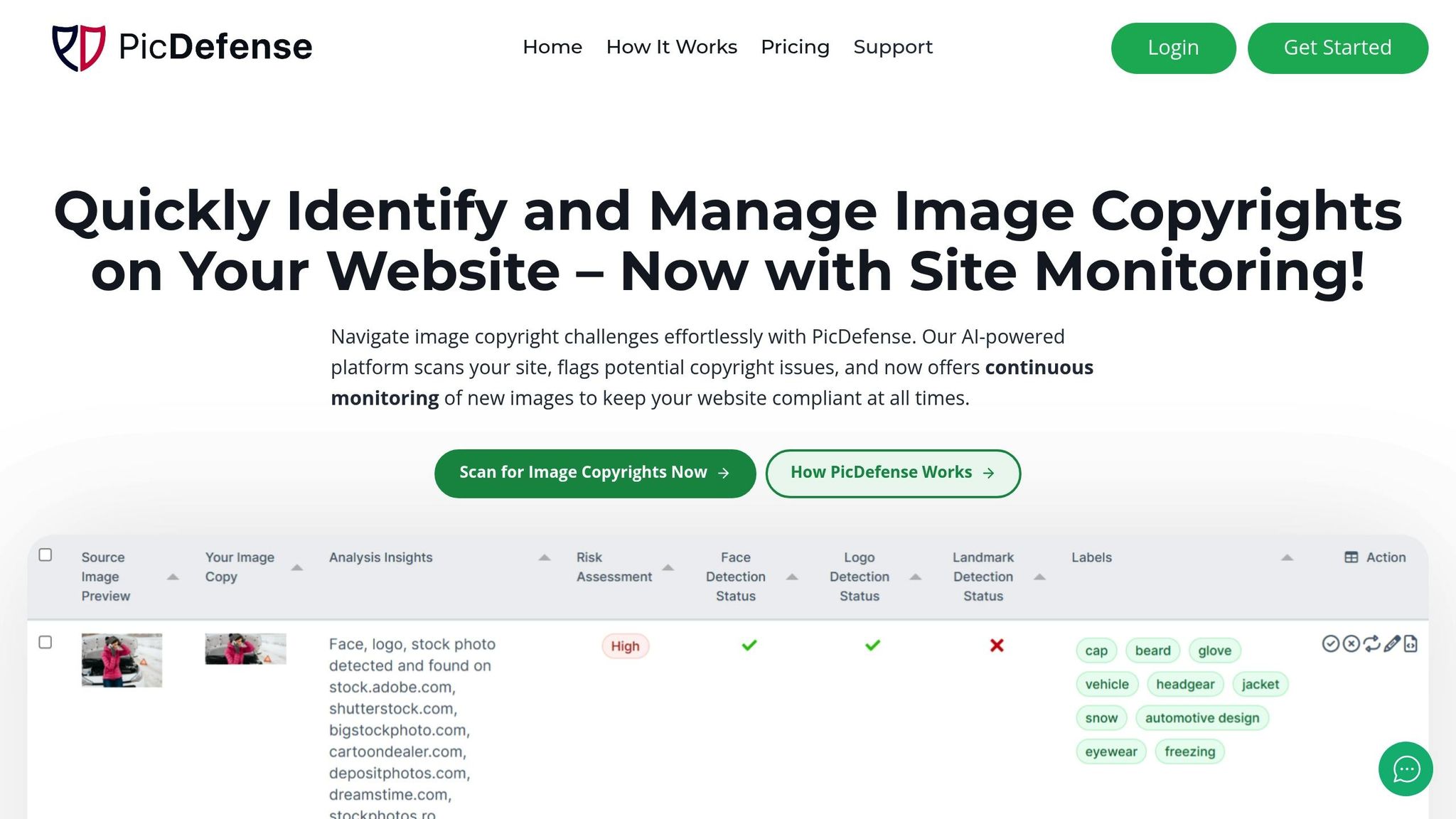
PicDefense.io streamlines this entire process into an automated platform designed for website owners and small to mid-sized businesses. It offers both bulk and individual image scans, making it easier to manage copyright risks.
The platform goes beyond basic image matching. It analyzes EXIF metadata, detects faces, logos, and landmarks, and performs reverse image searches within its database. If potential issues are found, PicDefense.io provides source tracing through backlinks, helping users pinpoint the original hosting source or stock image provider.
PicDefense.io also generates detailed compliance reports packed with actionable insights. These reports include PicRisk scores for each image and offer specific recommendations for reducing risks. For flagged high-risk images, the platform suggests replacements from sources like Pexels.
Another helpful feature is the whitelist option, which lets users mark images as cleared. This prevents those images from being flagged in future scans - a handy tool for businesses with proper licensing or original content.
With pricing starting at $75 for 500 images, PicDefense.io offers an affordable way for businesses to stay on top of copyright compliance with minimal hassle.
sbb-itb-59d21f2
Key Features and Benefits of AI Risk Scoring Platforms
AI-powered copyright risk platforms have reshaped how organizations handle image compliance by combining advanced technologies into a single solution.
Main Features for Copyright Risk Management
Platforms like PicDefense.io come equipped with a variety of tools to simplify and enhance image copyright management.
- Full-Site Scanning: This feature creates a comprehensive inventory of all images on your website. PicDefense.io automatically scans entire sites, ensuring no image goes unnoticed, giving you a clear picture of your copyright exposure [10].
- Advanced AI Analysis: Going beyond simple image matching, the platform analyzes EXIF metadata, identifies faces, logos, and landmarks, and conducts reverse image searches. It even generates keyword tags automatically, making it easier to organize and search for images [10].
- Source Tracing and Usage Tracking: By analyzing backlinks, the platform identifies where high-risk images originated and tracks their online usage. This helps confirm whether proper licensing is in place [10].
- License Management and Documentation: Users can store licensing details directly within the platform, creating a reliable compliance record. A whitelist feature also simplifies future reviews by marking images that have already been cleared [10].
- Risk Mitigation: The platform suggests compliant image alternatives for flagged content, helping you maintain your website’s visual appeal without compromising on compliance [10].
- Integration Options: PicDefense.io supports a WordPress plugin, API access, and Zapier integration, making it easy to incorporate into your existing workflows [10].
These tools work together to provide a seamless, end-to-end solution for managing image compliance.
Benefits of Automated Copyright Risk Scoring
Automated systems deliver a level of speed and precision that manual processes simply can’t match. Organizations that adopt such technologies have seen financial errors decrease by 75% [13].
- Efficiency and Speed: Tasks that would traditionally take hours - or even days - can now be completed in just minutes with automation [12].
- Accuracy and Consistency: Automated tools rely on predefined criteria for risk scoring, eliminating the errors and inconsistencies common in manual assessments [11].
- Real-Time Insights and Monitoring: PicDefense.io offers a Site Monitoring feature for $30 per month, allowing for weekly analysis of up to 150 images. It detects new images, provides timely alerts, and ensures continuous oversight [10].
- Improved Visibility: Centralized data and intuitive visualizations replace the fragmented and often confusing methods of manual processes [11].
Comparison: Manual vs. AI-Powered Risk Assessment
The advantages of AI-powered platforms become even clearer when compared to manual methods. Here's a quick breakdown:
| Process | Manual | AI-Powered Method |
|---|---|---|
| Data Collection | Fully reliant on human effort | Automated collection minimizes manual input |
| Data Organization | Often scattered across systems | Centralized for easy access and management |
| Risk Assessment | Subjective and error-prone | Consistent evaluations based on set criteria |
| Visualization | Limited and manual | User-friendly, graphical representations |
| Reporting | Time-consuming and prone to errors | Real-time, customizable automated reports |
| Follow-ups | Manual reminders, often overlooked | Automated notifications ensure timely action |
| Audit Trail | Minimal tracking | Comprehensive logs with timestamps |
Cost Efficiency is another strong point for automation. PicDefense.io offers plans starting at $75 for 500 images, which is far more economical than manual reviews [10].
Additionally, the platform emphasizes privacy and security. Images aren’t stored after analysis, and features like end-to-end encryption and strict access controls ensure your data stays protected - something that’s harder to guarantee with manual processes.
For businesses in the U.S., where copyright enforcement is becoming stricter, these automated platforms provide a reliable and efficient solution for safeguarding image assets.
Compliance Reporting and Risk Mitigation Strategies
Once risks are assessed, AI platforms step in with detailed reports and practical strategies to address compliance issues. These reports form the foundation for swift corrective actions.
AI-Generated Compliance Reports
AI-powered compliance reports break down copyright risks into clear, actionable insights. Each image is assigned a risk rating - high, medium, or low - based on factors like the likelihood of infringement, commercial use, and visibility [14][10]. This system helps businesses quickly prioritize pressing issues, such as unlicensed images or those featuring identifiable faces or logos that could lead to legal complications [10].
The reports also provide a summary of risk scores, explaining the reasoning behind each flagged image. For example, a report might highlight that an image appears across multiple stock photo platforms without proper licensing or contains watermarks indicating commercial ownership.
PicDefense.io takes this analysis further by comparing images against a massive database of over 67.1 billion indexed images. This ensures coverage even for altered or manipulated versions [10]. Additionally, their reports include direct links to licensing documentation and stock photo platforms, allowing businesses to address issues immediately.
Risk Mitigation Recommendations
After generating reports, AI platforms offer targeted recommendations to resolve copyright risks. These suggestions might include removing or replacing high-risk images, verifying licenses for flagged content, updating attributions, and maintaining detailed documentation of compliance actions for future reference [14][10].
PicDefense.io enhances this process by suggesting replacements from licensed sources like Pexels [10]. This feature is especially useful for businesses that need to keep their websites visually appealing while staying legally compliant.
The platform also supports ongoing monitoring and records all actions taken, which can serve as evidence of due diligence in case of a copyright dispute [14][10].
Experts encourage businesses to establish regular compliance audits, use only properly licensed images, register original works with the U.S. Copyright Office, and rely on AI tools for continuous monitoring. Training employees on copyright basics and embedding compliance checks into content workflows are also key to managing risks effectively [15][14].
How PicDefense.io Supports U.S. Businesses
To cater specifically to U.S. businesses, PicDefense.io provides a range of features tailored to American needs. Pricing is in U.S. dollars, with single scans starting at $75 for 500 images, making it easier for businesses to plan their compliance budgets [10].
The platform also integrates seamlessly into workflows with tools like a WordPress plugin, API access, and Zapier integration [10]. Compliance reports are aligned with U.S. copyright laws and business practices, offering actionable insights and mitigation strategies that fit within American legal standards. Support resources are localized for U.S. users, including appropriate date, time, and currency formats.
For ongoing protection, PicDefense.io offers a Site Monitoring service priced at $30 per month. This includes 150 image analyses per month, with unused credits rolling over. Additional scans cost $0.15 per image, providing a flexible, scalable solution for businesses of varying sizes [10]. This credit-based system ensures companies only pay for what they use, making compliance both manageable and cost-effective.
Conclusion: The Role of AI in Managing Copyright Risks
AI-driven tools are changing the game for copyright risk management, moving businesses from reactive approaches to more proactive strategies. What used to be a tedious, error-prone manual process is now streamlined with automation, allowing these systems to analyze thousands of images in just minutes.
These tools bring advanced risk scoring to the table, offering a solid defense against copyright infringement. Beyond spotting obvious issues, they can identify more nuanced risks, such as violations of personality rights, trademarked logos, and protected landmarks - details that often slip through in manual reviews. AI even excels at detecting altered or resized images by comparing them to vast databases, minimizing the chances of overlooking potential problems. This thorough process not only flags risks but also provides businesses with the data they need to act quickly and confidently.
With copyright litigation on the rise in the U.S., proactive management has become more critical than ever. The U.S. Copyright Office has noted an increase in lawsuits involving AI-generated or processed images, with high-profile cases like Getty Images vs. Stability AI underscoring the risks of using unverified content [16]. As regulators pay closer attention to AI-generated material, businesses must adopt tools that help them stay ahead of potential legal challenges.
Platforms like PicDefense.io simplify compliance by offering actionable insights and integrating seamlessly into existing workflows. Starting at $75 for 500 images, this solution makes enterprise-level copyright protection accessible to smaller businesses. By automating the compliance process, it helps companies navigate growing legal pressures efficiently and effectively.
AI-powered platforms also fit effortlessly into content creation workflows, thanks to tools like WordPress plugins, API integrations, and automation options through Zapier. This integration ensures compliance is built into the process from the start, preventing issues before they arise rather than scrambling to address them later.
As digital content continues to expand and copyright enforcement grows more complex, AI-powered copyright risk management is no longer a luxury - it’s becoming a necessity. These tools combine detailed analysis, automated monitoring, and actionable recommendations, giving businesses the confidence to use images responsibly while staying compliant. By adopting these proactive measures, companies can tackle copyright risks head-on and maintain their competitive edge in today’s fast-evolving digital world.
FAQs
How does AI help detect copyright risks in images more effectively?
AI simplifies the task of spotting copyright risks in images by using tools like metadata analysis, visual pattern recognition, and reverse image searches. These technologies enable AI to sift through massive amounts of images efficiently, catching potential copyright issues that manual reviews might overlook.
By automating this process, AI not only saves time and effort but also reduces the chances of human error. This gives website owners dependable insights to handle risks effectively and stay on top of copyright compliance without unnecessary hassle.
What are the risks for U.S. businesses that violate image copyright laws?
Failing to follow U.S. image copyright laws can result in serious legal and financial penalties. For businesses, statutory damages can range from $750 to $30,000 per infringement. If the violation is found to be intentional, the penalties can skyrocket to as much as $150,000. On top of that, companies might also be held responsible for actual damages and lost profits, which can lead to even greater financial losses.
In extreme situations, copyright infringement can escalate to criminal charges, which may include hefty fines and even imprisonment. These potential consequences underscore the need for businesses to carefully manage their image usage and ensure they comply with copyright laws to steer clear of costly legal troubles.
How does PicDefense.io help businesses manage image libraries and stay copyright compliant?
PicDefense.io is a platform designed to help businesses handle large image collections while ensuring copyright compliance. By leveraging AI-driven tools, it scans websites thoroughly, building a comprehensive catalog of all images and checking for possible copyright issues.
Its features include analyzing metadata, spotting elements like logos and landmarks, and performing reverse image searches to discover where images are used online and trace their origins. This process equips businesses with practical insights to resolve potential problems, swap out flagged images for compliant ones, and minimize legal risks with ease.
Protect your website from image copyright claims
PicDefense scans your entire website, identifies image risks, and stores proof of compliance — so you never get caught off guard.