Artificial intelligence is reshaping copyright law, sparking debates about ownership and creative rights. Here's the bottom line:
- AI-Generated Content: In the U.S., works created solely by AI cannot be copyrighted. Courts and the Copyright Office consistently require human authorship.
- AI-Assisted Content: If a human controls the creative elements while using AI as a tool, the work may qualify for copyright.
- Legal Risks: AI models trained on copyrighted materials may inadvertently reproduce protected content, exposing users to infringement claims.
- Global Differences: Copyright rules vary - while the U.S. and EU demand human creativity, China recognizes AI users as authors.
- Compliance Tips: Document your creative process, exclude AI-generated elements from copyright filings, and use tools trained on licensed data to reduce risks.
For businesses and creators, navigating these evolving rules is essential to protect assets and avoid legal trouble.
Can AI-Generated Content Be Copyrighted?
AI-Assisted vs AI-Generated Works: Copyright Eligibility Guide
In the United States, content created solely by AI cannot be copyrighted. Copyright law has always required human authorship, a principle rooted in the U.S. Constitution (Article I, Section 8, Clause 8) and upheld by the Copyright Act. Courts consistently affirm this stance, as seen in the famous 2016 "monkey selfie" case (Naruto v. Slater), where non-human creators were denied copyright claims [5].
The U.S. Copyright Office treats AI prompts as mere instructions or ideas. Since the AI system ultimately decides the final output, it’s the machine - not the human - that controls the creative expression. The Copyright Office’s 2025 report explains this clearly:
"No matter how many times a prompt is revised and resubmitted, the final output reflects the user's acceptance of the AI system's interpretation, rather than authorship of the expression it contains" [2].
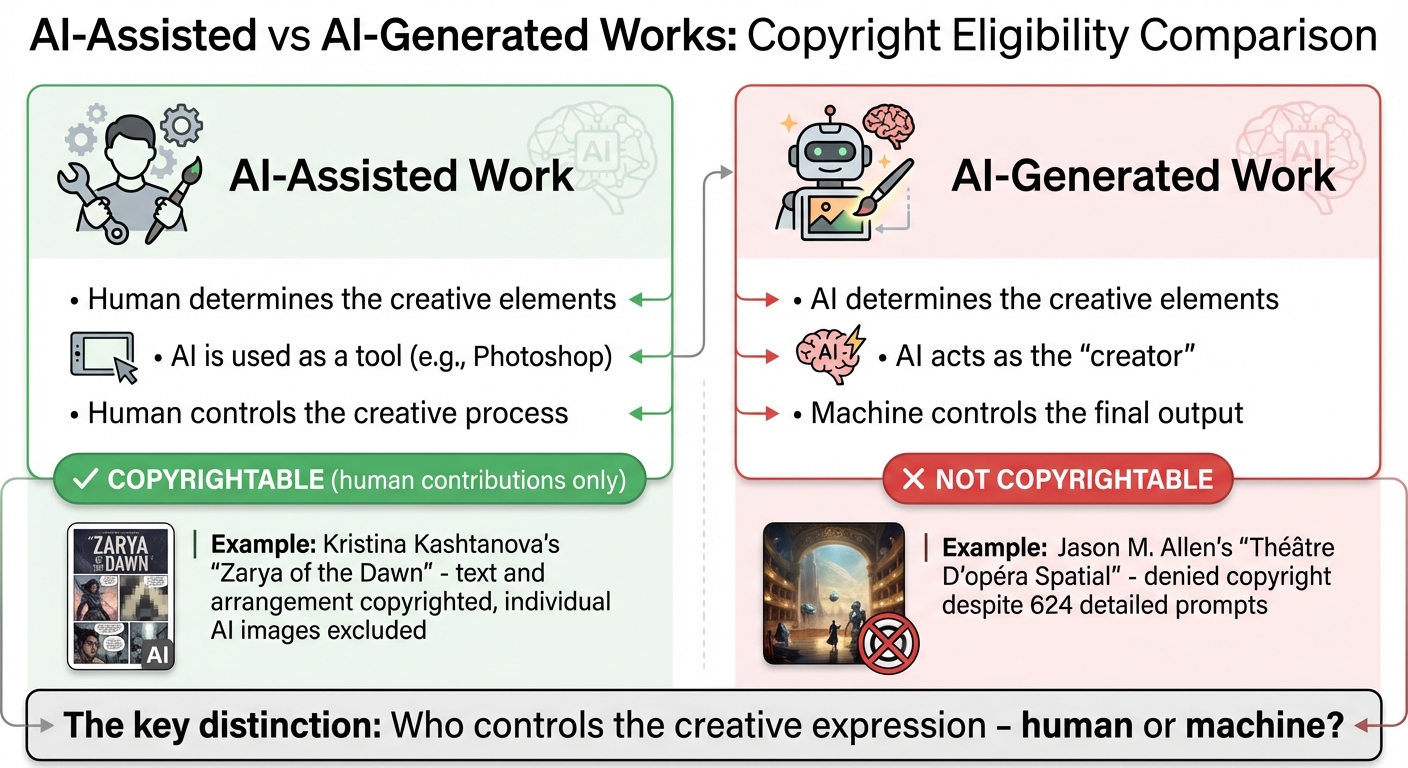
This distinction is pivotal. For example, in September 2023, Jason M. Allen tried to register Théâtre D'opéra Spatial, an award-winning image created using Midjourney. Despite providing 624 detailed prompts and making manual adjustments, the Copyright Office denied the registration. Their reasoning? AI-controlled expression does not qualify for copyright protection [5]. This case underscores how legal decisions continue to reinforce the necessity of human authorship in copyright law.
Why Copyright Law Requires Human Authorship
The demand for human authorship is deeply tied to the purpose of copyright itself. The U.S. Constitution grants Congress the power to protect the works of "authors" to encourage creativity and innovation. Importantly, courts interpret "authors" to exclusively mean human beings [4][5]. As Register of Copyrights Shira Perlmutter explained:
"Extending protection to material whose expressive elements are determined by a machine, however, would undermine rather than further the constitutional goals of copyright" [1].
The Copyright Office’s 2025 report also highlighted the societal value of human creativity:
"If authors cannot make a living from their craft, they are likely to produce fewer works. And in our view, society would be poorer if the sparks of human creativity become fewer or dimmer" [4].
In August 2023, a federal court upheld the Copyright Office’s decision to deny registration for a work Stephen Thaler claimed was created "autonomously" by his "Creativity Machine." The court reaffirmed that human authorship is an essential requirement for copyright [5]. These rulings emphasize why copyright law insists on human creative input.
AI-Assisted vs. AI-Generated Works
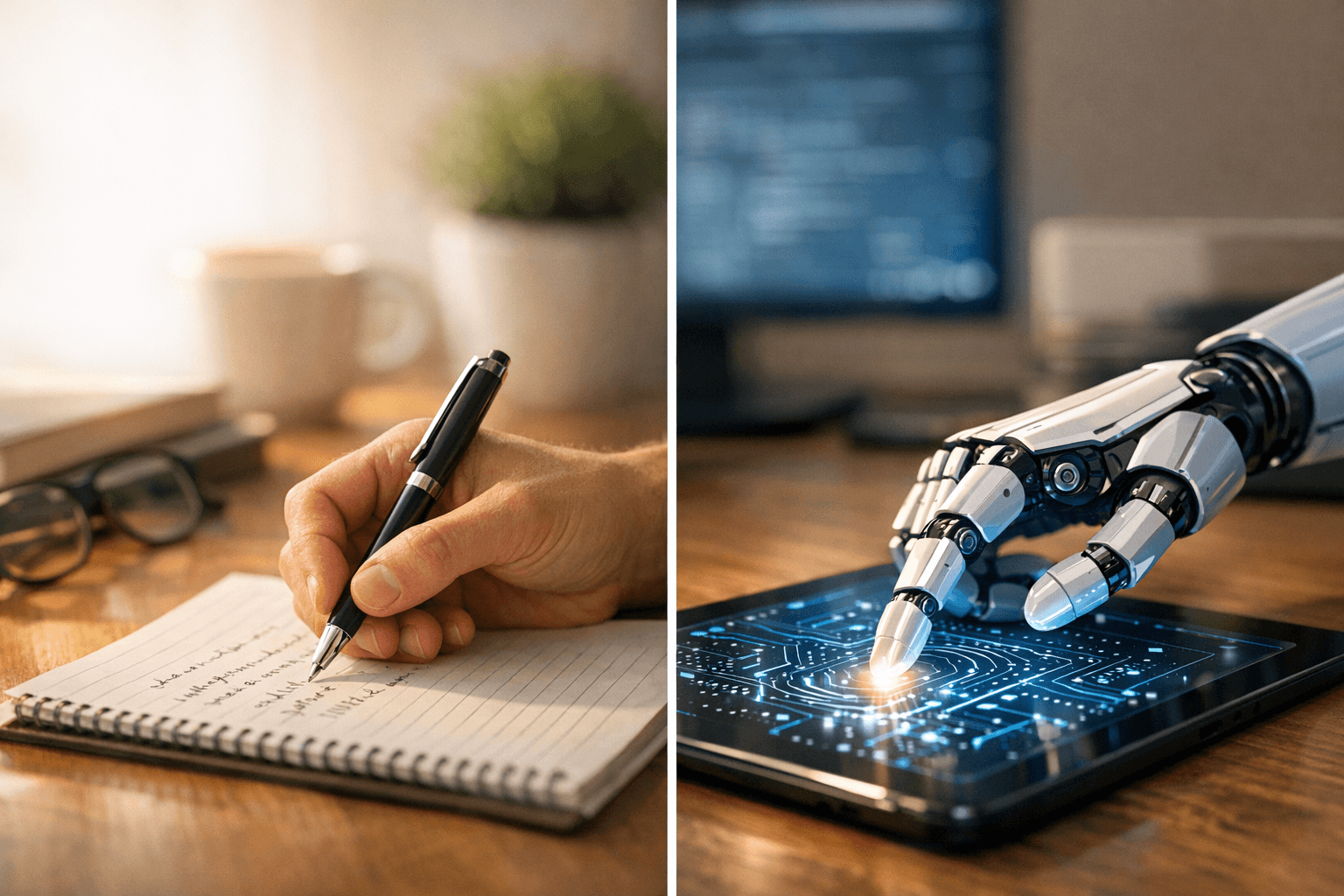
While AI-generated content cannot be copyrighted, AI can still play a role in human-driven creations. The key lies in who controls the creative process. If a human directs the expressive elements while using AI as a tool - similar to using Photoshop or a camera - the resulting work can be copyrighted. However, if the AI independently generates the creative elements, the output is not eligible for protection [7][4].
Here’s a quick breakdown:
| AI-Assisted Work | AI-Generated Work |
|---|---|
| Human determines the creative elements | AI determines the creative elements |
| AI is used as a tool (e.g., Photoshop) | AI acts as the "creator" |
| Copyrightable (human contributions only) | Not copyrightable |
An example of this distinction occurred in February 2023, when the Copyright Office granted partial protection to Kristina Kashtanova’s comic book Zarya of the Dawn. While she used Midjourney to create the images, only her human-authored text and the "selection, coordination, and arrangement" of those images were deemed copyrightable. The individual AI-generated images were excluded from protection [5].
A similar situation arose in December 2023, when an applicant submitted an image created by applying a "Starry Night" style to their own photograph using an AI tool. The Copyright Office denied registration, classifying the result as an AI-generated derivative work with insufficient new human authorship [5].
For website owners handling AI-generated content, these legal interpretations have direct implications for protecting your website from image copyright infringement. To safeguard your work:
- Document everything. Keep detailed records of your creative contributions, such as sketches, edits, and decisions.
- When filing for copyright, use the "Standard Application" and explicitly exclude AI-generated material in the "Material Excluded" field. Failing to disclose AI involvement could result in canceled registrations or dismissed infringement claims [5].
Copyright Risks from AI Training Data
AI models aren't conjuring content out of thin air. Instead, they rely on enormous datasets filled with copyrighted books, articles, images, music, and videos. This reliance creates potential legal risks - not just for the developers who build these tools but also for the users who depend on them. Let’s dive into how these practices unfold and the legal challenges they bring.
How AI Models Use Copyrighted Works
Training an AI model involves incorporating copyrighted materials into its datasets. By doing so, developers could face claims of direct and vicarious copyright infringement, along with potential violations of the DMCA if they remove copyright management information during the training process.
One notable case highlighting these risks is Andersen v. Stability AI Ltd. In October 2023, a California district court allowed direct infringement claims against Stability AI to move forward. The court emphasized that whether copyrighted images were copied or reconstructed during training was a factual matter that required further litigation. This case serves as a reminder that developers can’t assume their training methods are legally safe.
For end users, the risks arise if they commercially reproduce, distribute, or display AI-generated content that closely resembles copyrighted works. The key legal question is whether the AI model has retained substantial protectable expression from its training data. The U.S. Copyright Office explains:
"The question turns on whether the model has retained or memorized substantial protectable expression from the work(s) at issue." [9]
The Copyright Office takes a nuanced view of AI usage. While AI employed for research or analysis may fall under fair use, commercial models generating expressive content that competes with original works are treated differently. By December 2023, the Office had received over 10,000 public comments on the intersection of AI and copyright law. In May 2025, it released Part 3 of its detailed report on generative AI training [6].
The Office’s stance is firm:
"Making commercial use of vast troves of copyrighted works to produce expressive content that competes with them in existing markets, especially where this is accomplished through illegal access, goes beyond established fair use boundaries." [8]
These legal risks highlight the urgent need for clearer regulations, which brings us to the topic of emerging licensing frameworks.
New Licensing Frameworks
The legal gray areas surrounding AI training are pushing companies toward adopting licensing agreements that compensate creators and provide developers with lawful access to training materials.
The Copyright Office has acknowledged that fair use isn’t a blanket solution:
"Various uses of copyrighted works in AI training are likely to be transformative. The extent to which they are fair, however, will depend on what works were used, from what source, for what purpose, and with what controls on the outputs - all of which can affect the market." [8]
This case-by-case approach means businesses must carefully evaluate the AI tools they rely on. Opting for models trained on licensed or public domain datasets can significantly reduce legal risks. Before using AI-generated content commercially, it’s crucial to assess whether the output could serve as a market substitute for the original works - this substantially increases the risk of infringement. Businesses should implement strategies for preventing future copyright infringements when integrating these tools.
In May 2025, Register of Copyrights Shira Perlmutter was abruptly dismissed after releasing a report critical of Big Tech’s AI training practices, underscoring the intense pressures surrounding these policy decisions [8].
When AI Outputs Copy Copyrighted Content
Even with the best intentions, AI can unintentionally produce content that mirrors copyrighted material - putting you at risk of legal trouble. Generative AI systems function as "black boxes", meaning neither users nor developers can fully predict how the training data influences the output [4]. This unpredictability makes it crucial for website owners to adopt strict compliance and risk management strategies. Without realizing it, you might publish content that closely resembles someone else’s copyrighted work.
Consider an incident in January 2025 involving Google's Gemini. When prompted to generate an image of a cat smoking a pipe and reading a newspaper, the system unexpectedly included an "incongruous human hand" in the output [2]. This example highlights the lack of user control over AI outputs, making it nearly impossible to guarantee that generated content won’t replicate protected works.
If AI-generated content is too similar to copyrighted material in its training data, it could lead to infringement claims - even if the replication was accidental. Courts have consistently ruled that "copying a copy" holds the same legal weight as copying the original work [5]. Additionally, pure AI-generated content cannot qualify for copyright protection [4]. This means that if an AI output replicates someone else’s work, you could face liability without having any copyright protections of your own.
Fair Use vs. Infringement in AI-Generated Content
Determining whether AI-generated content falls under fair use or constitutes infringement is decided case by case - there’s no universal rule [4][7]. A key factor is whether a human exercised enough control over the creative aspects of the work or if the AI essentially replaced human creativity.
Human involvement matters more than the complexity of your prompts. The U.S. Copyright Office has made it clear that even highly detailed prompts don’t provide the level of human control needed to establish authorship [4].
The distinction lies in how AI is used. If AI serves as a tool to brainstorm or draft preliminary outlines (without directly using its output), it’s generally considered an assistive, non-infringing use [7]. However, incorporating AI-generated content that mirrors protected works significantly increases the risk of infringement.
Another critical factor is whether a copyrighted work is "perceptible in the output" [7]. For instance, if you input your original work into an AI tool and it remains recognizable in the output, you may retain copyright protection for that portion. However, the unpredictable nature of AI systems makes it difficult to ensure your creative intent is fully preserved.
Risks with Trademarks and Likenesses
AI-generated content that reproduces logos, trademarks, or individuals’ likenesses can lead to immediate legal issues, even if the replication was unintentional [1]. These risks extend beyond copyright law, touching on trademark and right of publicity claims, which can be expensive to defend. The U.S. Copyright Office has raised concerns about "digital replicas" that falsely portray individuals. In May 2025, after receiving over 10,000 public comments on AI and copyright matters, the Office recommended new federal legislation to address the unauthorized use of AI-generated likenesses [1][3].
Website owners are especially vulnerable. If your AI tool generates an image featuring a recognizable brand logo or a person’s likeness without proper authorization, you could face legal claims - even if you had no idea the AI would produce such content. The "black-box" nature of AI makes it impossible to predict when these elements might appear, underscoring the importance of proactive risk management. One effective way to manage this is to conduct an image audit to identify potential liabilities. These challenges highlight why robust strategies are essential, which we’ll explore in the next section.
sbb-itb-59d21f2
How to Manage AI Copyright Risks
Tackling AI copyright risks requires thoughtful planning, from choosing the right tools to keeping detailed records and leveraging automation for compliance.
Use AI Tools with Licensed Training Data
The data used to train an AI system plays a critical role in determining whether its outputs might infringe on copyrighted works. To reduce this risk, opt for AI platforms that rely on licensed datasets. This ensures the content generated is less likely to mirror protected material[5]. When assessing AI tools for your business, ask for transparency about their training data sources - vague or unclear licensing should be a red flag. While platforms with licensed datasets may cost more, that expense is minimal compared to the potential fallout from copyright infringement claims.
Document Image Sources and Licenses
Thorough documentation is your best defense against copyright disputes. The U.S. Copyright Office mandates that applicants exclude AI-generated content exceeding de minimis levels from copyright registrations[5]. Without clear records of an image's origin, any edits made, and its licensing details, your work could be at risk.
Keep detailed logs of how AI tools are used, including specific prompts and a breakdown of human contributions[5]. Save all relevant documents, such as receipts, license agreements, and purchase dates for images. A case in point: in February 2023, the U.S. Copyright Office granted Kristina Kashtanova copyright registration for her comic book Zarya of the Dawn, but only for the human-written text and the creative arrangement of images - not the individual images generated by Midjourney. This decision highlighted that when users lack sufficient control over the AI's output, the AI itself - not the user - becomes the author of those elements[5].
Under 17 U.S.C. § 411(b), a court can invalidate a copyright registration if AI-generated content isn’t properly disclosed[5]. Once you’ve established a strong record-keeping system, consider automating these processes to simplify compliance.
Automate Compliance with PicDefense.io

performing a manual copyright infringement audit can be tedious and prone to mistakes, especially as your website or portfolio grows. PicDefense.io offers an automated solution, scanning your website to pinpoint copyright risks and compiling records ready for audits. It also suggests copyright-free image alternatives to reduce exposure.
This platform uses AI to analyze EXIF metadata, identify faces, logos, and landmarks, and perform reverse image searches via TinEye and Google Vision to track online appearances of your images. PicDefense.io acts as a centralized hub for managing compliance, allowing you to store licensing details, including source attribution, purchase dates, and license files. With this system in place, you’ll have everything you need to address copyright questions confidently.
Whether you’re managing a personal blog or overseeing multiple client websites, automated compliance tools like PicDefense.io can save time and ensure you’re protected. Visit PicDefense.io to start scanning your site and building a solid foundation of documentation today.
The Future of Copyright in the AI Era
Copyright law is undergoing rapid changes as courts and regulatory bodies grapple with the implications of AI on creative works. Staying informed on these developments is essential to navigating legal risks and ensuring compliance and avoiding copyright issues.
Legislative Efforts and Case Law Updates
The U.S. Copyright Office has been actively addressing AI-related copyright challenges through a series of comprehensive reports. The first report, released in July 2024, proposed federal legislation to counter unauthorized "digital replicas" - AI-generated likenesses of real individuals [1][10]. The second report, published in January 2025, clarified that AI-generated outputs can only be protected under copyright if a human plays a significant role in creatively arranging or modifying the material [1]. The third report, expected in May 2025, will focus on the legality of training AI systems on copyrighted works. It suggests that voluntary licensing markets should emerge organically, without direct government intervention [10][11].
Recent court rulings are also shaping how copyright law applies to AI training data. In Bartz v. Anthropic PBC (June 2025), the U.S. District Court for the Northern District of California ruled that training the AI model "Claude" on books constituted fair use due to its "transformative" nature. However, the court found that using pirated books for training violated fair use principles, leading to a class action certification for affected authors in July 2025 [11]. Conversely, in Kadrey v. Meta Platforms, Inc. (June 2025), another judge in the same district determined that training Meta's "Llama" model on "shadow libraries" was fair use, creating a notable disagreement between the two cases [11]. These conflicting rulings highlight the ongoing uncertainty in defining the boundaries of fair use in AI training.
Meanwhile, Congress has adopted a cautious approach, with over 10,000 public comments reflecting widespread public concern [10][3]. This regulatory ambiguity emphasizes the importance of automated tools to help businesses and creators navigate compliance with these evolving standards.
The Role of Technology in Compliance
Technology is becoming an essential ally in meeting new copyright requirements. AI-powered tools can distinguish between human-created and AI-generated content, a critical feature for adhering to the U.S. Copyright Office's guidelines on disclaiming non-human authorship in copyright registration applications [5]. These tools also provide documentation of human creative input, which is crucial for ensuring copyright eligibility and defending against potential infringement claims [5].
Beyond registration, advanced compliance platforms can identify AI-generated content that closely resembles copyrighted works, helping to minimize accidental infringement risks [5]. For instance, users can check images for copyright by scanning URLs to identify potential risks. Under current regulations, any AI-generated material that constitutes more than a minimal contribution must be explicitly excluded from copyright applications. Failing to do so could result in the court invalidating the registration altogether [5].
As legislative measures expand to safeguard digital replicas and personal likenesses from unauthorized AI use [1], monitoring technologies will play a key role in detecting and addressing potential violations before they escalate into legal disputes.
Conclusion
AI is changing the landscape of copyright law, pushing website owners to rethink their legal strategies. According to the U.S. Copyright Office, content generated solely by AI doesn’t qualify for copyright protection because it lacks the required human authorship. This means competitors could legally replicate your AI-created marketing materials, product descriptions, or images without violating copyright laws[12][13]. At the same time, you could face personal liability if that same AI-generated content infringes on someone else’s copyrighted work, with potential statutory damages reaching up to $150,000 per image[12].
Given these risks, it’s essential to take a proactive stance on copyright compliance. As copyright standards evolve, documenting your creative processes and using tools to identify potential similarities in content can help safeguard your business[12][14].
This is where PicDefense.io steps in. The platform automates compliance by scanning your entire website for copyright risks. It uses advanced AI detection to analyze images and helps you document proper licensing by storing purchase dates and source attributions. Acting as a centralized hub, it allows you to upload receipts, track licenses, and maintain audit-ready records - exactly the kind of documentation you’ll need if a copyright dispute arises.
FAQs
What legal risks should businesses consider when using AI-generated content?
Businesses leveraging AI-generated content - whether it's text, images, or other media - should understand a key point about U.S. copyright law: only works with a human author can qualify for copyright protection. This means that content created entirely by AI cannot be copyrighted. However, if a person adds a creative touch, like refining prompts or editing the AI's output to incorporate human input, that work may be eligible for protection.
Another important consideration is the risk of copyright infringement. AI models are trained on existing works, and there’s a possibility that the output could unintentionally replicate protected elements from the training data. If businesses publish or distribute such content, they could be held legally responsible, even if the infringement was accidental. To minimize this risk, it’s essential to document human contributions, obtain proper licenses for any source materials, and use tools to detect potential copyright issues.
For website owners, platforms like PicDefense.io offer valuable support. These tools can automatically scan websites for images that might infringe on copyright, trace back to the original sources, and even suggest royalty-free alternatives. By adopting such safeguards, businesses can stay on the right side of copyright law and avoid costly legal challenges.
How can creators secure copyright protection for works made with AI assistance?
To make sure AI-assisted creations qualify for copyright protection, creators need to show human involvement in the final work. Under U.S. copyright law, a human must contribute meaningful creative input - works generated entirely by AI don’t meet the criteria.
Here’s how creators can meet this requirement:
- Use AI tools as partners rather than replacements, ensuring they make distinct creative decisions that go beyond the AI's output.
- Keep detailed records of their process, including prompts, edits, and any decisions that influenced the final result.
- Avoid incorporating copyrighted material in prompts or training data unless they have the proper licenses.
- Register the completed work with the U.S. Copyright Office to document human involvement and secure legal protections.
By actively shaping the creative process and maintaining thorough documentation, creators can meet the standards for copyright eligibility and safeguard their AI-assisted works.
How can businesses reduce the risk of copyright infringement when using AI?
To reduce copyright risks when using AI, businesses should mix smart legal strategies with practical tools. Start by securing proper licenses for any data used to train AI models and keeping detailed records of its sources. Adding a human touch - like crafting creative prompts or making edits to AI-generated content - can also satisfy copyright laws, as U.S. law still requires human authorship for protection. Filing registrations that openly disclose AI’s involvement can further clarify ownership and discourage potential disputes.
AI-powered tools like PicDefense.io can be a game-changer in managing these risks. These tools can scan websites, analyze images for copyright concerns, and suggest licensed alternatives for flagged content. For instance, PicDefense can identify faces, logos, and metadata, while performing reverse image searches to trace original sources. This helps businesses stay compliant and steer clear of legal troubles.
Lastly, staying updated on copyright policy changes is crucial. Keep an eye on updates from the U.S. Copyright Office and weave them into your processes to ensure compliance while making the most of AI’s creative capabilities.
Protect your website from image copyright claims
PicDefense scans your entire website, identifies image risks, and stores proof of compliance — so you never get caught off guard.