Using free image platforms like Pixabay and Pexels might feel like a convenient solution, but they come with serious risks. Here's what you need to know:
- Legal Liability: These platforms shift all responsibility for copyright compliance onto the user. If an image is later found to infringe copyright, you could face fines up to $150,000 per infringement under U.S. law.
- Unverified Content: Images are uploaded by users without ownership verification, increasing the chances of using copyrighted or improperly licensed material.
- License Changes: Platforms can change their license terms, potentially invalidating previously "safe" images.
- No Model or Property Releases: Many images lack the necessary permissions for identifiable people or locations, exposing you to privacy or trademark claims.
For businesses, the risks include costly legal battles, demand letters, and operational disruptions. To avoid these pitfalls, focus on proper sourcing, maintain detailed records, and verify image rights. Tools like PicDefense can help by scanning websites, analyzing risks, and organizing licensing documentation to protect your business.
License Changes and Retroactive Enforcement
Free image platforms might seem like a safe bet, but their licensing terms can shift without warning. These changes can leave users vulnerable to unexpected legal headaches, including the sudden revocation of licenses for images they’ve used in good faith.
License Revocations Put Businesses at Risk
When platforms change their licensing rules, even images that were once legally used can become a source of trouble. Under U.S. copyright law, businesses can face serious financial penalties if an image they’ve used is later deemed non-compliant. Often, the first sign of trouble comes in the form of a demand letter, which can lead to expensive and time-consuming legal battles.
Verifying Image Sources Is Challenging
Tracking down the original source of an image is no small feat. The way images are shared and re-uploaded across platforms creates layers of confusion about who owns the rights. An image might start with one licensing agreement, only to be re-uploaded elsewhere without proper permissions. This tangled web makes it incredibly hard to determine whether an image is safe to use, even if it initially appeared to be.
Retroactive Copyright Claims Can Be Costly
Copyright law in the U.S. allows rights holders a specific window of time to file infringement claims. Unfortunately, this means that even images used for years without issue can suddenly become legal liabilities. The fallout? Statutory damages and hefty legal fees, which often aren’t covered by general liability insurance. Since platforms typically distance themselves from copyright disputes, the burden - and the risk - rests entirely on the user.
User-Uploaded Copyright Violations
One of the biggest risks with free image platforms lies in their reliance on unverified, user-generated content. These platforms allow anyone to upload images without confirming whether the uploader actually owns the rights. This lack of oversight can lead to unauthorized use, putting businesses at risk of legal trouble.
Users Upload Images They Don’t Own
Platforms like Pixabay and Pexels accept image submissions from users without verifying ownership. This means individuals might upload images they don’t have the rights to, leaving businesses exposed to potential copyright infringement claims from the original owners. Unlike professional sources, these platforms don’t offer the same level of assurance when it comes to image rights.
"They do not verify who owns the images, and they take no responsibility if you get sued for using them." - Jump Story [2]
Missing Model and Property Releases
Another major issue is the frequent absence of model and property releases in user-uploaded images. Professional stock photo providers typically ensure that images come with proper model releases (for identifiable people) and property releases (for recognizable locations). These releases are critical for commercial use. However, free platforms rarely include these protections, leaving businesses exposed to privacy, publicity, or even trademark claims. This lack of documentation adds a layer of legal uncertainty that can be costly.
User-Uploaded vs. Verified Sources: Risk Comparison
The table below highlights the key differences between free platforms with user-uploaded content and professional, verified sources:
| Aspect | User-Uploaded (Free Platforms) | Verified Professional Sources |
|---|---|---|
| Ownership verification | None – platforms don’t verify image ownership | Full verification of photographer/creator rights |
| Model releases | Rarely included or verified | Required and documented for commercial use |
| Property permissions | Not checked or provided | Verified for recognizable locations and properties |
| Legal protection | User assumes all liability | Platform provides legal backing and insurance |
| Copyright documentation | No proof of rights or permissions | Clear chain of title and licensing terms |
Professional stock photo services go the extra mile to verify ownership, secure all necessary releases, and offer legal protections. This makes them a far safer option compared to free platforms, which leave users to navigate the murky waters of copyright and liability on their own.
Legal Risks and Demand Letters: What U.S. Businesses Face
Using free images without thorough verification can put U.S. businesses in a precarious position, opening the door to copyright claims, demand letters, and hefty financial penalties. What might seem like a simple website image can quickly turn into an expensive liability. Let’s break down how these copyright demand letters operate and the potential consequences they bring.
How Copyright Demand Letters Work
Copyright owners and their representatives actively monitor the internet for unauthorized use of their work. When they find an image being used without proper licensing, they send demand letters to the offending party. These letters typically include detailed claims, evidence like screenshots or metadata, and a demand for immediate settlement. If the business cannot produce valid licensing records, there’s often little room to contest the claim.
Financial and Legal Consequences
Settling these claims can be expensive, but the costs escalate dramatically if the issue progresses to a lawsuit. Legal fees and damages can far surpass what it would have cost to properly license the image in the first place. Beyond the financial toll, businesses face operational disruptions as they divert resources to address the legal fallout. The situation is further complicated by the fact that free image platforms explicitly state that users bear all responsibility for verifying image rights, leaving businesses vulnerable if something goes wrong.
Free Image Platforms Disclaim All Responsibility
Free image platforms often advertise their content as "free for any purpose", but they shift all legal risk onto the user. Businesses are solely responsible for verifying that the images they use are legally safe. Since these platforms allow anyone to upload content - regardless of whether they hold the rights - there’s always a chance that an image may come with hidden legal risks. When disputes arise, these platforms typically point to their disclaimers, leaving businesses to shoulder the full burden of any legal or financial consequences.
sbb-itb-59d21f2
Safe Sourcing and Compliance Strategies
Shifting from reactive damage control to a proactive approach in compliance management can save businesses from unnecessary legal headaches. By implementing proper sourcing practices and maintaining systematic documentation, companies can protect themselves from potential copyright issues.
Best Practices for Safe Image Sourcing
Always verify the source and license terms of each image by reviewing the actual agreement, not just relying on platform tags. Images marked as "free" often come with specific attribution requirements or restrictions that, if overlooked, could lead to violations.
Keep detailed records of image downloads, including purchase receipts, license agreements, and acquisition dates. This documentation is invaluable if copyright holders use tools like archive.org to prove their images appeared on your site without authorization. Without proper records, proving legitimate usage rights becomes nearly impossible.
Steer clear of images featuring people, recognizable locations, or branded products unless you have the necessary releases. For instance, a photo of Times Square or a snapshot of people in a coffee shop might seem harmless but often requires additional permissions that free platforms don't provide.
Check EXIF data and run reverse image searches to determine if an image originates from professional sources that may require licensing. These steps can help identify potential risks before using an image.
By following these practices, businesses can establish a strong foundation for managing compliance with the help of automated solutions.
How PicDefense Helps U.S. Businesses Stay Compliant
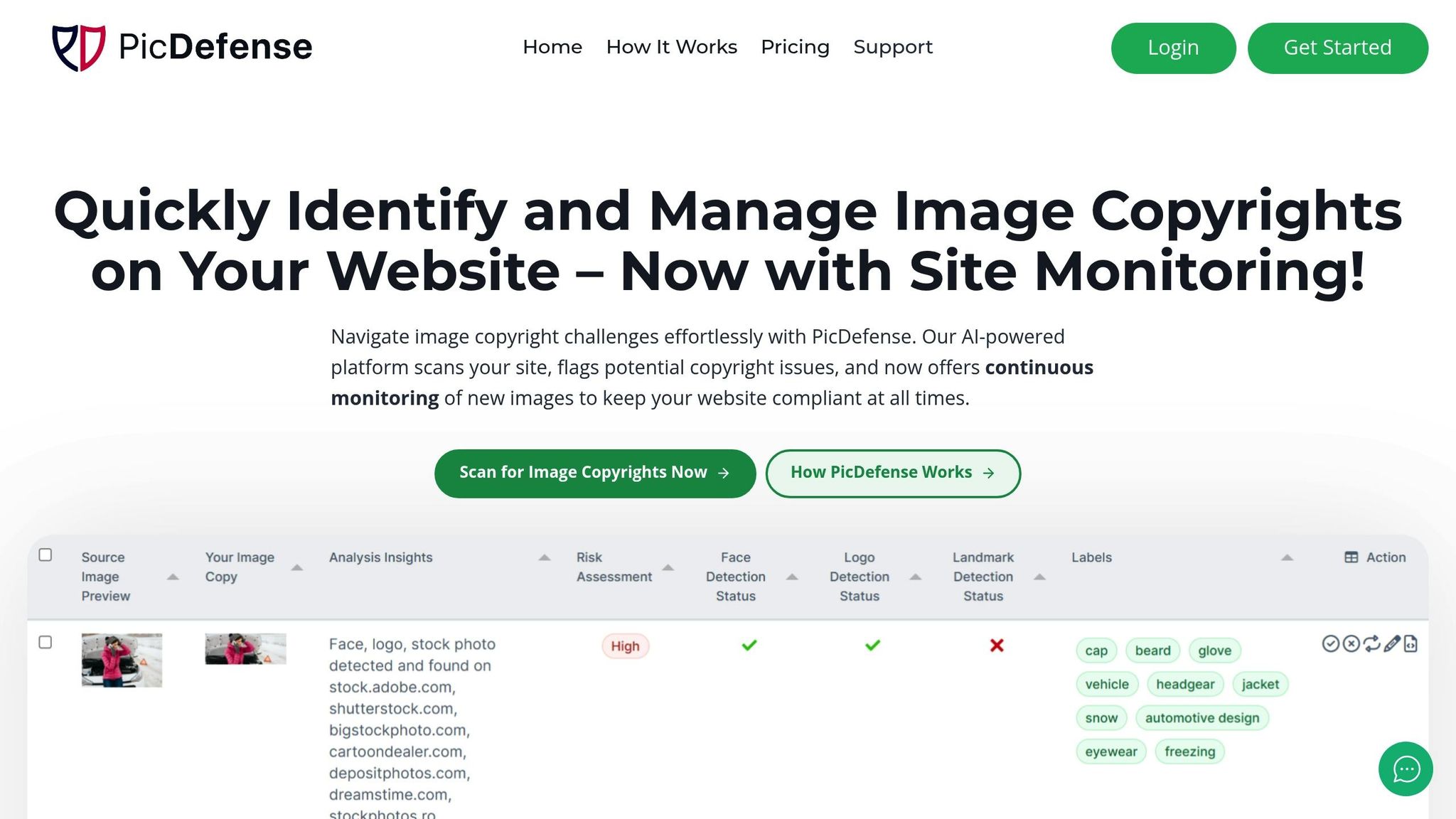
While best practices are essential, automated tools can take compliance efforts to the next level. PicDefense simplifies the process with automated website scanning and AI-powered risk analysis. The platform scans websites to create detailed image inventories and uses advanced detection techniques - like EXIF metadata analysis, face and logo recognition, and reverse image searches through tools like TinEye and Google Vision - to flag potential copyright risks.
The system assigns PicRisk ratings to each image, helping businesses prioritize which ones need immediate attention. For example, high-risk images might include those with professional metadata, detected faces lacking model releases, or images found on multiple stock photo platforms with varying licensing terms.
License documentation storage is another key feature, turning messy and disorganized files into an organized, searchable archive. This makes it easier to provide proof of licensing when needed.
The platform’s Smart Rules feature further streamlines workflows by automating actions based on risk levels. Businesses can set up alerts for high-risk images or create approval processes for images requiring additional verification. These tools ensure compliance efforts are both efficient and thorough.
Centralized Image Management with PicDefense
Managing compliance across multiple websites can become increasingly complex as businesses expand. PicDefense simplifies this with a centralized dashboard that allows companies to track and document image ownership across numerous websites in one place.
API integrations with tools like Zapier and Make.com connect compliance workflows with existing processes. Marketing teams can use these integrations to verify new images before publishing, while legal teams receive notifications when high-risk images are flagged.
For agencies managing multiple client websites, bulk processing capabilities are a game-changer. These tools allow agencies to scan thousands of images at once and generate compliance reports for each client. The whitelist functionality also makes ongoing management easier by marking verified images as safe, eliminating the need for repeated scans.
Additionally, exportable compliance reports provide legal teams with detailed, auditable records. These reports include licensing information, purchase dates, and risk assessments, demonstrating good faith efforts to stay compliant and defend against copyright claims.
Summary: Balancing Convenience and Compliance
Free image platforms might seem like a quick fix, but they come with hidden risks that can lead to major expenses for U.S. businesses. Around 85% of the 3 billion images shared online daily are stolen [3].
Every image is automatically copyrighted upon creation, which means even "free" images often require proper licensing [1][3][5].
Key Risks of Free Platforms
Using free image platforms isn't without dangers. Issues like shifting license terms, retroactive enforcement, and unverified user uploads can expose businesses to serious legal trouble. Copyright infringement penalties can climb as high as $150,000 per image if deemed willful [4][5]. These aren't just hypothetical scenarios - they're real costs businesses face when copyright holders take legal action.
The most alarming aspect? Free image platforms take no responsibility for copyright claims. Their terms of service place all liability on the user, leaving businesses to navigate costly legal disputes on their own. With risks this substantial, having a solid compliance strategy is crucial.
How PicDefense Provides Peace of Mind
PicDefense steps in as a complete compliance solution, helping businesses navigate the high stakes of copyright risks with confidence. Here's how it works:
- Automated compliance monitoring: PicDefense scans websites to build detailed image inventories and uses AI to uncover copyright risks. By analyzing EXIF metadata, detecting faces and logos, and performing reverse image searches, the platform identifies issues that manual checks might miss.
- Organized legal documentation: Forget scrambling for purchase receipts or license agreements. PicDefense stores all documentation in a searchable archive. If a copyright holder uses archive.org timestamps to claim infringement, businesses can immediately provide proof of purchase, license terms, and source attribution - often resolving disputes before they escalate.
- Risk management tools: The PicRisk rating system flags high-risk images that need urgent attention, while Smart Rules automate routine compliance tasks. For agencies managing multiple websites, bulk processing makes it easy to audit thousands of images at once.
Investing in compliance tools like PicDefense can save businesses from costly legal battles. With copyright infringement claims ranging from $3,000 to $150,000 per image, PicDefense's credit-based pricing - starting at just $0.07 per image for large-scale scans - is a bargain. Even more valuable is the peace of mind that comes from knowing your image use is secure and legally sound.
FAQs
What legal risks should I be aware of when using free images from platforms like Pixabay or Pexels?
Using free images from sites like Pixabay or Pexels might seem convenient, but it can come with serious legal risks. Why? These platforms depend on user-uploaded content, and they don’t always confirm whether the person uploading the image actually owns the rights. This means an image labeled as "free to use" could still violate someone else’s intellectual property rights.
If the true owner of an image discovers it being used without permission, you could face costly lawsuits or be required to pay damages - sometimes in the thousands of dollars. And that’s not all. Licensing terms for these images can change over time, and those changes might even apply retroactively. Plus, images featuring trademarks, recognizable people, or other copyrighted elements can create additional legal headaches, even if the platform originally claimed they were free to use.
The best way to steer clear of these problems? Be diligent. Always verify the licensing and ownership of any image before using it. It’s worth the extra effort to protect yourself from potential legal trouble.
How can businesses ensure the images they use are properly licensed and free from copyright issues?
When using images, businesses need to ensure they’re not stepping into copyright trouble. Start by verifying the ownership and licensing of any image you plan to use. Look for clues like attribution, watermarks, or metadata that might point to the creator. A reverse image search can also be a helpful tool to track down the original source. If you’re unsure about who owns the rights, it’s a smart move to reach out to the creator directly to secure proper permission or licensing.
Additionally, keep thorough records of all licensing agreements and any correspondence related to image use. These documents can serve as essential evidence if you ever face a dispute or accusations of infringement.
How can businesses avoid legal risks when using images from free image websites?
To reduce legal risks when using images from free platforms, it's crucial for businesses to confirm that the images are clearly licensed for commercial use. Look for licenses like CC0, which release images from copyright restrictions. However, always double-check the platform's specific terms to make sure you're following the rules.
Be especially careful with user-uploaded content, as some images might be uploaded without proper permissions. Steer clear of images with unclear or questionable licensing. Additionally, maintain thorough records of the image source, license type, and the date you downloaded it. This documentation can act as proof if any copyright disputes arise.
By following these practices, you can safeguard your business from legal troubles and ensure you're using images responsibly.
Protect your website from image copyright claims
PicDefense scans your entire website, identifies image risks, and stores proof of compliance — so you never get caught off guard.