Using images without proper permission can cost businesses between $3,000 and $150,000 per image in legal penalties. Advanced AI tools now make it easier to detect misuse, even for altered or resized images. This 2025 report highlights the growing risks of copyright violations, enforcement trends, and how industries are affected. Key insights:
- AI Detection: Copyright holders use AI to scan millions of images daily, flagging potential violations with precision.
- Industry-Specific Risks:
- E-commerce: High claim volume due to frequent image use.
- Media & Publishing: Highest settlement costs due to heavy reliance on editorial content.
- Marketing Agencies: Risk multiplies with repeated use of unlicensed images.
- Regional Differences: Courts in California impose higher costs due to stricter enforcement, while New York offers more leniency.
- Prevention Costs: Automated compliance systems cost $1,200–$7,000 annually, far less than potential settlements.
Businesses must prioritize proper licensing, maintain detailed records, and use compliance tools to avoid financial and reputational damage.
Settlement Costs by Industry
After examining enforcement trends, let’s dive into how settlement costs vary across industries. Copyright infringement settlements can differ greatly depending on the business sector. Knowing these industry-specific nuances helps companies gauge their risk and prepare effective compliance strategies.
Average Settlement Amounts by Industry
Settlement demands often reflect an industry’s image usage habits, business practices, and financial capacity. Here’s how some industries typically fare:
- E-commerce: Online retailers rely heavily on product photos, lifestyle images, and promotional graphics. While individual settlement amounts might not be overwhelming, the sheer volume of claims can add up quickly, especially if proper licensing isn’t in place.
- Digital Marketing Agencies: Agencies running multiple campaigns often face compounded settlement figures. Using an unlicensed image across several campaigns amplifies the damages.
- SaaS Companies: While individual settlements in this sector tend to be smaller, the reliance on website visuals for conversion optimization makes these companies frequent enforcement targets.
- Publishing & Media: With content creation at the heart of their business, media companies and publishers face some of the highest settlements due to their extensive use of editorial and stock imagery.
- Real Estate & Healthcare: These industries have distinct image needs - ranging from property listings and virtual staging to patient-related visuals and medical marketing materials - which can influence the scale of settlement demands.
What Affects Settlement Amounts
Several factors determine how much a company might have to pay in a copyright infringement settlement:
- Business Revenue and Size: Larger companies often face higher settlement demands, as copyright holders may scale claims based on a company’s ability to pay.
- Commercial Usage Type: Images used directly in advertising or sales promotions typically result in higher penalties compared to those used for less prominent purposes, like website decoration.
- Duration and Scope of Infringement: Prolonged or widespread use of an unlicensed image can drive up settlement amounts, whereas brief or isolated usage might result in lower demands.
- Number of Simultaneous Infringements: Using the same image in multiple places or campaigns can significantly increase liability, with each instance adding to the overall settlement.
- Image Modification and Attribution: Altering an image without proper attribution can signal intentional infringement, often leading to steeper penalties.
- Response Timing and Cooperation: Addressing a demand letter quickly and providing documentation to clarify rights can help lower settlement amounts. On the other hand, delays or inadequate responses may escalate the situation.
- Geographic Location: Businesses in major metropolitan areas may face stricter enforcement, partly due to the higher concentration of copyright monitoring services and specialized legal expertise.
These factors highlight the importance of maintaining strict image compliance and thorough recordkeeping to mitigate risks.
Copyright Enforcement Across US Regions
When it comes to copyright enforcement in the United States, the landscape is anything but uniform. Regional differences in how federal judicial circuits handle infringement cases, combined with state-specific laws, create a patchwork of rules that significantly influence financial risks, settlement outcomes, and litigation strategies. For businesses, understanding these variations is crucial to assessing potential exposure based on their location and operations.
Settlement Costs by Region
The Second Circuit (covering New York, Connecticut, and Vermont) and the Ninth Circuit (covering California, Washington, Oregon, and other western states) offer a striking contrast in their approaches to copyright enforcement. These differences directly shape settlement negotiations and litigation costs.
In the Second Circuit, courts in New York take a more streamlined approach to evaluating copyright cases. Judges often rely on "good eyes and common sense" to assess claims of substantial similarity, frequently dismissing weaker cases before they even reach the costly discovery phase [1]. This dismissal-friendly environment tends to favor defendants, leading to lower settlement demands since copyright holders are aware of the higher likelihood of their cases being thrown out.
On the other hand, the Ninth Circuit presents a more challenging environment for defendants. Courts in California apply a dual-test system that makes early dismissals difficult. The subjective "intrinsic test", for example, is deemed to be "exclusively the province of the jury", which means cases are far less likely to be dismissed before discovery [1]. This procedural hurdle often strengthens the negotiating position of copyright holders, resulting in higher settlement demands.
Adding to the complexity, the use of expert testimony varies between these regions. In New York, expert testimony is generally deemed unnecessary except for highly technical works, such as software [1]. Meanwhile, California courts often require expert testimony during the "extrinsic" phase of analysis, which can significantly increase litigation costs.
These procedural differences influence strategies on both sides. Plaintiffs with strong claims often prefer the more plaintiff-friendly California courts, while defendants tend to favor New York, where dismissals are more common [1].
State Cases and Laws That Matter
Beyond the federal circuit differences, state-level policies introduce another layer of complexity. States differ in how they handle copyright claims over government-created content, which can have significant implications for businesses that use materials from state agencies, educational institutions, or local governments.
Some states, like Arizona, Colorado, New York, Pennsylvania, South Carolina, Utah, and Washington, actively claim copyright over government-produced materials [2]. In contrast, others, such as Florida, Massachusetts, New Jersey, and North Carolina, treat government works as public domain, allowing them to be reused without licenses [2].
California strikes a balance, permitting copyright for specific state-created materials while keeping general government records in the public domain under the Public Records Act [2]. Indiana prohibits agencies from charging licenses or royalties for public records unless explicitly authorized by law [2]. Meanwhile, Minnesota has conflicting legal opinions on the matter, leaving the issue unresolved in its courts [2].
At the federal level, the "government edicts doctrine" offers some clarity by prohibiting copyright claims on official legal materials like statutes and judicial opinions. However, this protection doesn’t extend to all government-created content, leaving businesses to navigate a maze of gray areas [2].
These state and regional differences have a direct impact on how businesses approach compliance. Companies operating across multiple states must account for varying enforcement environments, settlement expectations, and policies on government-created content. For those with significant operations in California, the cost and complexity of litigation are likely to be higher. Meanwhile, businesses in Second Circuit states may face a different set of risks and settlement dynamics. These disparities highlight the importance of a proactive compliance strategy to avoid unnecessary costs and complications.
Copyright Enforcement Trends and Technology
The copyright enforcement landscape in 2025 is undergoing significant changes as artificial intelligence (AI) reshapes how copyright holders and businesses manage image rights. Advances in technology are introducing new ways to detect infringement and driving regulatory updates that emphasize the importance of staying ahead with compliance.
AI Detection and Compliance Tools
AI is becoming a cornerstone for managing image rights. Copyright holders now use sophisticated systems capable of rapidly scanning online content. These tools analyze metadata, visual elements, and usage patterns to pinpoint potential infringements. Similarly, businesses are turning to automated solutions to handle intellectual property portfolios. These tools assist with patent searches, competitor tracking, and ongoing monitoring for any signs of infringement.
"By 2025, businesses will increasingly rely on AI-powered platforms to automate patent searches, competitor tracking, and infringement monitoring. These tools not only save time but also provide insights that can lead to better decision-making." - IamIP [3]
Modern compliance platforms combine multiple detection methods, such as reverse image searches, metadata analysis, and visual recognition technologies. This layered approach ensures thorough risk assessments for digital asset libraries, pushing enforcement strategies to evolve in response.
Evolving Enforcement Tactics
With AI innovations driving progress, enforcement strategies are adapting to meet emerging challenges. Digital rights management firms are joining forces with government cyber units to systematically track and address online copyright violations. At the same time, regulatory reforms are requiring platforms to implement automated filtering systems and robust notice-and-takedown mechanisms. This highlights the growing need for businesses to maintain organized and accessible licensing records.
"Governments worldwide are reforming copyright frameworks to address these challenges. Simultaneously, businesses are adopting AI-driven tools to monitor and safeguard their digital creations." - IamIP [3]
Proactive Measures and Documentation
A key part of enforcement now involves leveraging digital records in conjunction with AI-based compliance tools. For instance, some entities have used timestamps from archive.org to challenge the legitimacy of image licenses. This underscores the importance of keeping detailed, verifiable records of image ownership and licensing agreements.
These developments make it clear: combining AI-powered detection with meticulous documentation is critical for reducing the risks and financial burdens tied to copyright infringement.
sbb-itb-59d21f2
How Businesses Can Prevent Copyright Problems
With the rise of AI detection and enforcement, businesses face potential settlements ranging from $3,000 to $150,000 per image for copyright infringements. Relying solely on reactive measures can be risky and costly, making proactive systems a smarter choice to avoid these claims. Establishing automated compliance systems is no longer optional - it's a necessity for protecting your business.
Setting Up Image Compliance Systems
Managing digital image inventories manually is nearly impossible when dealing with hundreds or even thousands of images across websites and marketing channels. This is where automated systems come into play, offering a scalable solution for compliance.
These systems work by scanning entire websites to catalog every image in use. They employ advanced tools like EXIF metadata analysis, reverse image searches, and visual recognition technology to identify faces, logos, and landmarks. The result? A detailed inventory that helps businesses stay on top of their image usage.
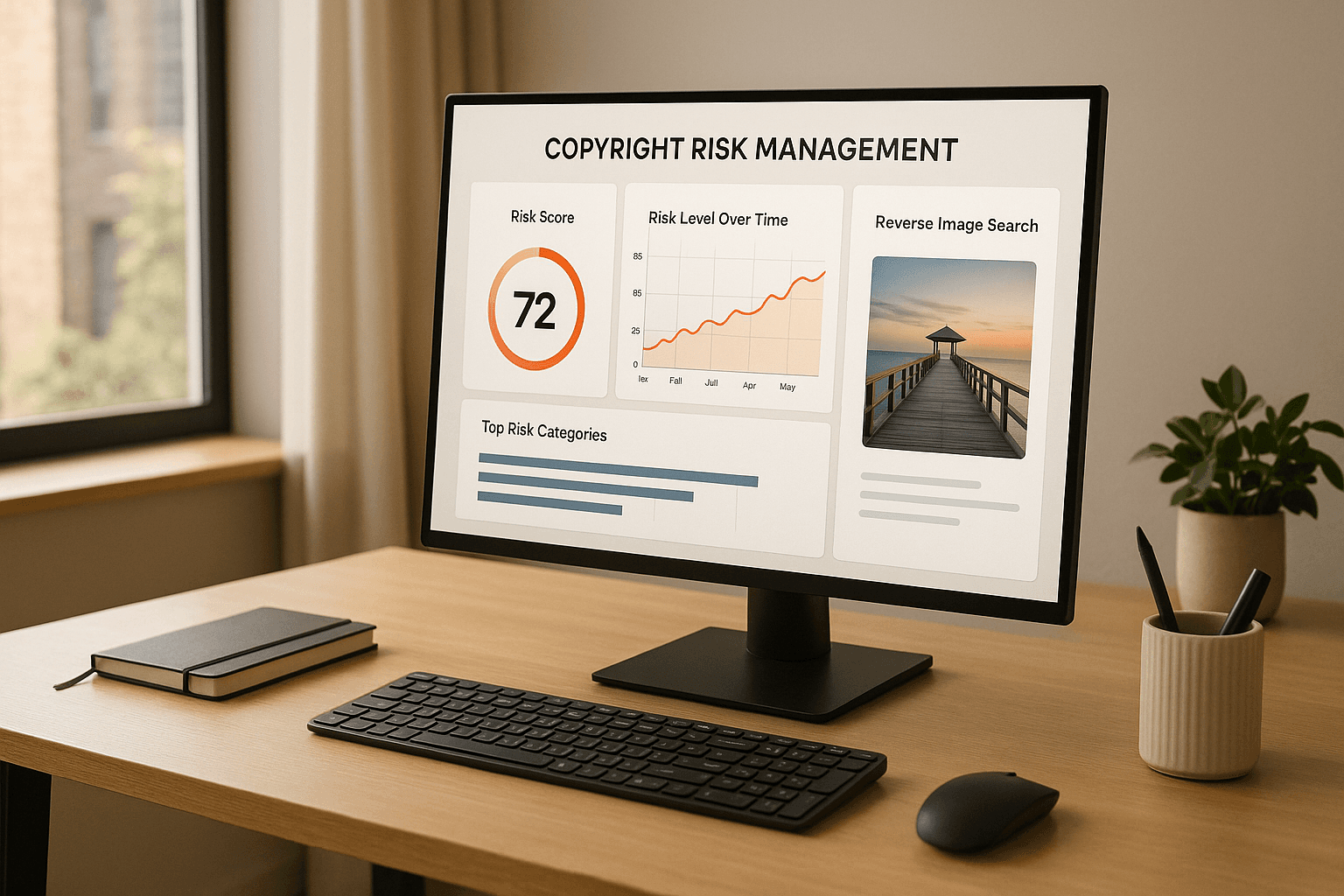
To prioritize efforts, these systems assign risk scores to images based on factors like missing metadata, professional photography characteristics, or matches found in reverse image databases. High-risk images can then be flagged for further documentation, ensuring the most vulnerable assets are well-protected.
Integration is another key feature. Modern platforms can connect directly to tools like content management systems, marketing software, and collaboration platforms through APIs or automation tools like Zapier. This ensures new images are automatically added to the compliance system as they’re uploaded, making compliance a seamless part of daily operations.
Keeping License and Ownership Records
While automated systems handle the heavy lifting, maintaining thorough licensing and ownership records is equally important. If a copyright claim arises, businesses need to respond quickly with proper documentation. Without it, the pressure to settle can be overwhelming.
Centralizing these records in a searchable database is crucial. Linking licenses directly to the corresponding images ensures that nothing gets lost, even if key personnel leave the company. This centralized approach can be a lifesaver during legal disputes.
Additionally, accurate records of purchase dates and timestamps provide solid evidence of compliant licensing practices. Documentation should also include details like the original source of the image, photographer credits, license type, usage restrictions, and expiration dates. These records act as a safeguard against claims and help businesses respond confidently to any disputes.
Compliance Costs vs Infringement Costs
When comparing the costs of proactive compliance to reactive settlements, the numbers speak for themselves. Investing in compliance systems - typically costing between $1,200 and $7,000 annually - can save businesses from settlements that range from thousands to tens of thousands of dollars per image.
For example, a company managing 5,000 images might spend about $650 on initial compliance scanning. In contrast, the cost of resolving even a single infringement claim could far exceed this amount. Add to that the hidden costs of legal fees, employee time spent addressing claims, operational disruptions, and potential damage to your reputation, and the case for proactive compliance becomes even stronger.
Here’s a quick comparison of proactive compliance versus reactive settlements:
| Cost Comparison | Proactive Compliance | Reactive Settlement |
|---|---|---|
| Initial Setup | $650 - $7,000 | $0 |
| Per Image Protection | $0.07 - $0.20 | $3,000 - $150,000 |
| Legal Defense Capability | Strong documentation | Weaker position |
| Business Disruption | Minimal | Significant |
| Long-term Protection | Ongoing | Per incident |
As businesses scale, these systems become even more cost-effective. The cost per image decreases with larger inventories, making proactive compliance a far better investment than addressing infringement claims one by one.
Conclusion: Preventing High Infringement Costs
By 2025, the landscape of image copyright enforcement has shifted dramatically, bringing with it financial risks that businesses cannot afford to ignore. Adapting to these changes and taking preemptive action is now more critical than ever in today’s increasingly litigious digital world.
Key Findings from the 2025 Report
Our analysis of enforcement trends and regional differences highlights the pressing need for businesses to stay ahead of copyright compliance. With the rise of advanced AI tools, infringement detection has become faster and more precise, fundamentally altering how copyright enforcement operates.
The financial consequences of image copyright violations have reached staggering levels. Settlement demands now affect businesses of all sizes, regardless of whether the infringement was intentional or accidental. This demonstrates the growing financial stakes for companies across every industry.
One of the most impactful developments is the role of artificial intelligence in copyright enforcement. AI systems now scan millions of images daily, identifying potential violations with unmatched speed and accuracy. This means even images used years ago without proper documentation can trigger claims, often backed by timestamps from platforms like archive.org that predate a company’s licensing records.
Adding to this challenge is the rise of large-scale legal campaigns targeting entire industries. These campaigns use AI to uncover hundreds of potential infringements, which are then pursued systematically for settlements. This efficiency has made copyright enforcement highly profitable, leading to a surge in demand letters. These trends emphasize the necessity for businesses to adopt effective copyright compliance measures.
Why Copyright Compliance Matters
The cost of proactive compliance is negligible compared to the financial, legal, and reputational damage caused by copyright infringement. But the impact goes beyond money. Businesses that face demand letters also deal with operational disruptions and the risk of long-term reputational harm.
In today’s digital environment, compliance requires more than good intentions or outdated manual processes. The sheer volume of image usage demands automated tools capable of scanning websites, assessing copyright risks, and maintaining solid documentation. PicDefense offers a systematic approach to compliance by providing detailed image inventories and centralized license management, as outlined earlier.
The platform’s AI-driven analysis flags high-risk images before they escalate into legal issues, while its documentation tools ensure businesses can respond effectively to claims. Compared to the potential costs of settlements, investing in protection is a straightforward decision.
In 2025, safeguarding your business against copyright risks isn’t just a smart move - it’s essential. Proactive compliance tools aren’t just an option; they’re a necessity for any business aiming to navigate this high-stakes enforcement environment without financial or operational setbacks.
FAQs
What are the best ways for businesses to use AI tools to avoid image copyright infringement?
To steer clear of image copyright infringement, businesses can use AI tools responsibly by following these important practices:
- Secure proper licenses for all training data to ensure its use is legal and to mitigate risks.
- Use public domain or open-source data for training, which helps avoid potential copyright issues.
- Steer clear of high-risk content in datasets, such as pirated or copyrighted material.
- Maintain detailed records of training data sources as proof of compliance with copyright regulations.
These steps can help businesses reduce legal risks while promoting responsible and ethical use of AI tools.
What factors determine settlement amounts for image copyright infringement in various industries?
Settlement amounts for image copyright infringement depend on several key factors. These include the purpose and nature of the use, whether the infringement was deliberate, the type and worth of the copyrighted work, and the effect the infringement has on the market value of the original piece.
Statutory damages generally fall between $750 and $30,000, but if the violation is found to be willful, that amount can climb to $150,000. Additionally, considerations like industry standards and local enforcement practices may influence the ultimate settlement figure.
How do regional differences in copyright enforcement impact legal risks and strategies for U.S. businesses?
Regional variations in copyright enforcement across the United States can play a big role in shaping the legal risks businesses face and the strategies they choose. State-specific legal precedents, how local courts interpret the law, and enforcement priorities can all contribute to different levels of risk depending on where a business operates or where a potential copyright issue arises.
For businesses leveraging AI tools to generate content, the U.S. Copyright Office has made it clear: copyright protection requires human authorship. This means companies need to carefully assess whether their AI-assisted creations meet the criteria for copyright protection. If there's uncertainty about eligibility, businesses may have to lean more heavily on contractual agreements or trade secrets to protect their intellectual property. Keeping up with regional enforcement patterns is crucial to reducing legal risks.
Protect your website from image copyright claims
PicDefense scans your entire website, identifies image risks, and stores proof of compliance — so you never get caught off guard.