
Using copyrighted images without proper permission can lead to serious legal and financial problems for e-commerce businesses. This includes fines ranging from $750 to $150,000 per image, account suspensions on platforms like Amazon and Shopify, and even the destruction of infringing materials. Many retailers mistakenly believe they own the rights to supplier-provided images, but without explicit licensing agreements, they remain at risk.
Here’s what you need to know:
- Copyright is automatic: Ownership belongs to the creator unless rights are explicitly transferred.
- Supplier images aren’t always safe: Even if a supplier provides photos, you need written proof of usage rights.
- Platforms demand proof: Amazon and Shopify require sellers to document image licenses to avoid penalties.
- Organized records are key: License agreements, receipts, and usage rights must be stored and accessible for years.
- Tools like PicDefense.io can help: Automated systems scan, flag risks, and store documentation for compliance.
To protect your business, audit your image library, secure proper licenses, and maintain detailed records. Compliance isn’t optional - it’s a safeguard against costly disputes and platform penalties.
Common Problems in E-Commerce Image Compliance
Managing image copyright compliance in e-commerce is no small feat. Retailers often grapple with unclear ownership rules, inconsistent supplier data, and the need to maintain accurate documentation over time. These challenges can create significant risks if not addressed properly.
Who Owns Product Images: Suppliers vs. Retailers
A major hurdle is determining who actually owns the product images. Retailers typically rely on suppliers for these images, but suppliers often provide incomplete or inaccurate licensing information [4]. This leaves retailers with the responsibility of verifying the authenticity and rights of each image to avoid potential legal issues. The rise of AI-generated images has added another layer of complexity, raising ethical and legal questions when their use isn’t transparently disclosed [3].
Different Rules for Amazon and Shopify

Compliance becomes even trickier when selling across multiple platforms like Amazon and Shopify. Each platform has its own licensing requirements and enforcement practices, forcing retailers to navigate a maze of rules. This highlights the importance of creating a unified strategy to manage compliance across all sales channels.
Proving You Own Images Years Later
Keeping track of image ownership over the long term is another challenge. Records can become scattered or lost, making it difficult to prove licensing rights years down the line. To address this, retailers need reliable systems that can consistently track and verify supplier data, ensuring they maintain clear evidence of image rights [4].
Legal Requirements and Documentation for Image Compliance
E-commerce retailers need to stay on top of image copyright laws to avoid costly legal disputes and penalties from platforms. Below, we’ll break down the essentials of U.S. copyright law, the key documents you need, and what platforms like Amazon and Shopify expect from sellers.
U.S. Copyright Law Basics
In the U.S., creative works are automatically protected by copyright as soon as they’re created and fixed in a tangible form. The copyright typically belongs to the photographer or their employer unless it’s explicitly transferred through a written agreement. This can get tricky because buying a product doesn’t mean you own the rights to its images. Retailers often assume otherwise, which can lead to expensive copyright infringement claims.
While copyright registration isn’t required for protection, it does come with major legal benefits. Registered copyrights allow the owner to pursue statutory damages up to $150,000 per work for willful infringement, plus attorney fees. This is one reason why copyright holders are increasingly aggressive about pursuing unauthorized image use, especially in e-commerce.
Required Documents for Compliance
Having the right documentation is your best defense against copyright claims. License agreements are the cornerstone of compliance and should clearly outline which images you’re allowed to use, how you can use them, and for how long. Make sure these agreements specify commercial usage rights and whether you’re allowed to modify the images.
Keep detailed records such as purchase receipts, invoices, and download confirmations to prove you have legitimate usage rights. For custom photography, ensure contracts explicitly transfer copyright ownership or grant broad usage licenses.
Source attribution records are just as important. These should include the photographer’s name, the creation date, and any licensing terms. This information is essential if platforms or copyright holders challenge your right to use specific images. A systematic cataloging process for this data is a smart move for managing your product photo inventory.
Don’t forget about model and property releases. If your product photos feature people or recognizable private property, you’ll need signed releases granting permission for commercial use. Without these, you could face additional legal issues beyond copyright infringement.
Platform Documentation Requirements
Platforms like Amazon and Shopify have strict documentation standards for handling copyright complaints. On Amazon, sellers must provide solid evidence of their rights to disputed images, such as purchase receipts, licensing agreements, or proof of copyright ownership. Amazon operates on tight timelines, so having this documentation readily available is crucial.
Amazon’s Brand Registry program offers extra protection but requires trademark registration and detailed documentation of your brand’s assets. Sellers who fail to provide sufficient proof risk having their listings removed or even losing their accounts.
Shopify’s process under the Digital Millennium Copyright Act (DMCA) works differently. When a copyright holder files a takedown notice, Shopify removes the content immediately and asks questions later. Store owners must file counter-notices with supporting documentation to restore their listings, a process that can take 10-14 business days. During this time, your products remain unavailable for sale.
Both platforms keep track of copyright violations, and repeated offenses can lead to permanent account suspensions. Even worse, they share this violation data with other marketplaces, potentially affecting your ability to sell on multiple channels.
To stay ahead, retailers should create platform-specific documentation packages that meet the requirements of each marketplace. This means organizing license agreements, receipts, and usage permissions in a way that allows for quick submission during disputes. Investing in these systems not only protects your business but also ensures smoother operations when copyright challenges arise. These practices lay the groundwork for the automated solutions discussed in the next section.
How PicDefense.io Solves Image Compliance Problems
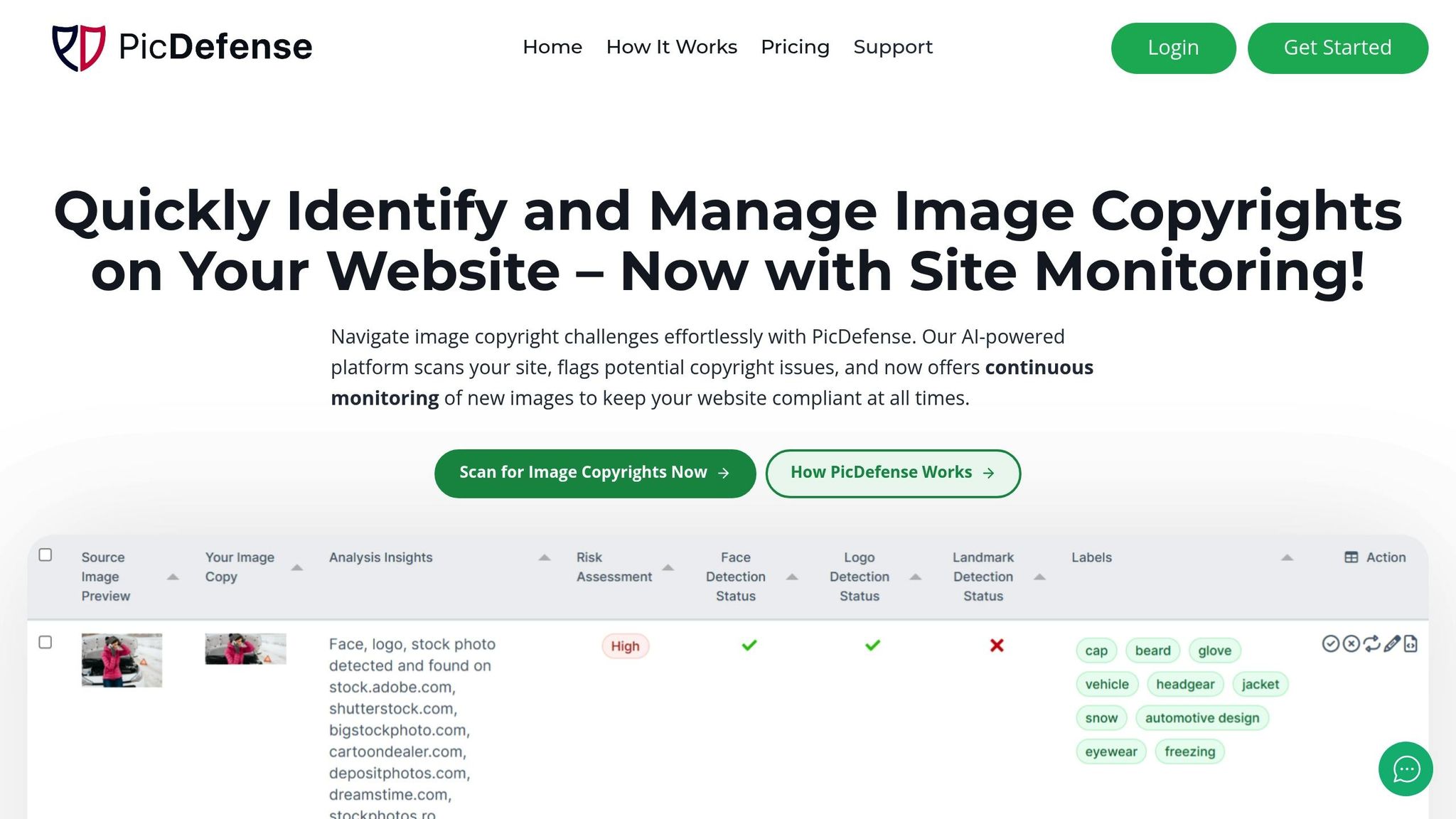
PicDefense.io tackles the complex challenges of image compliance with a streamlined, automated approach. Managing thousands of images manually is nearly impossible, but this platform takes the guesswork out of the process, helping to avoid copyright issues before they turn into costly legal problems. Here’s how PicDefense.io simplifies compliance and reduces risk.
Automated Website Scanning and Risk Detection
PicDefense.io uses advanced AI to scan all images on your website against a massive database of 73 billion entries [5][6]. Unlike standard reverse image searches, it can identify altered or manipulated versions of copyrighted images. Whether your site is small or has thousands of images, the platform handles scans efficiently, completing smaller sites in minutes and processing larger ones without overloading your servers.
The AI goes beyond just scanning images - it analyzes EXIF data to detect faces, logos, and landmarks that could trigger copyright claims. It also flags images from stock libraries with expired or invalid licenses. To keep your site compliant, the weekly Site Monitoring feature sends real-time alerts for any new, unverified images added to your site.
License Storage and Organization System
PicDefense.io acts as a one-stop compliance hub. You can upload purchase receipts, license files, and proof of ownership directly alongside flagged images. Having organized records, including purchase dates and license agreements, can save you from lengthy legal headaches. Once an image is verified as licensed or owned, you can mark it as safe to prevent future flags during scans.
The platform’s automation tools also enhance compliance efforts, making it easier to assess and respond to risks.
Smart Rules and Risk Scoring Features
Each image on your site is assigned a detailed PicRisk score, offering actionable insights into its copyright risk. The Smart Rules feature lets you customize compliance workflows to fit your business needs. For example, you can categorize images, set up alerts for high-risk content, or assign specific violations to team members. When issues arise, PicDefense.io provides clear recommendations, like reviewing EXIF data, tracing image sources for proper rights, or suggesting alternatives that are safe for commercial use.
These tools address the documentation and ownership challenges many businesses face, giving you the confidence to manage your image library effectively.
Pricing: Site Monitoring costs $30/month for 150 image analyses, with unused credits rolling over. Additional scans are $0.15 per image, and plans cover up to three websites. For one-time scans, pricing starts at $85 for 500 images or $150 for 1,000 images.
sbb-itb-59d21f2
Best Practices for E-Commerce Image Compliance
Navigating the challenges of image ownership and meeting platform requirements can be tricky. To stay on the right side of copyright laws, e-commerce businesses need a solid strategy that includes regular audits, careful recordkeeping, and smart sourcing practices.
Run Regular Image Audits
Combining automated tools with manual reviews is one of the most effective ways to identify and address compliance issues. Monthly or quarterly audits, paired with weekly checks, help catch problems early - especially as new images are added to your site.
Automated tools are particularly useful for flagging high-risk images. They can identify those missing proper licensing or highlight potential copyright concerns, saving time and reducing human error[1]. For instance, they can quickly spot images uploaded by team members from suppliers or manufacturers without verifying licensing. Weekly monitoring acts as an extra layer of protection, ensuring that new additions to your product catalog meet compliance standards.
While audits help address immediate risks, maintaining detailed records is critical for safeguarding your business in the long run.
Keep Detailed License Records
To protect against copyright claims, maintain a centralized system for storing purchase receipts, license agreements, and other documentation for every image you use. Paying for an image or hiring a photographer isn’t enough to transfer copyright ownership - you need a written agreement to secure those rights[7]. This is especially true for in-house or commissioned work, where contracts should clearly outline copyright ownership or work-for-hire terms[7].
Why is this important? The costs of defending a copyright claim can far exceed the price of proper licensing or original photography[2]. Organized records, complete with timestamps, purchase dates, and license agreements, can save you from costly legal battles and potential settlements.
For additional protection, consider registering your images with the U.S. Copyright Office. While this requires extra effort, it provides solid legal proof of ownership and strengthens your position in case of disputes[8].
Create Image Whitelists and Find Safe Alternatives
Proactive sourcing methods, like using image whitelists, can significantly reduce the risk of compliance issues. An image whitelist is a curated collection of verified and approved images that your team can safely use. This prevents unauthorized images from being published and offers a reliable resource for compliant visuals.
To build a whitelist, start by vetting images for proper licensing. Use trusted sources such as public domain libraries, Creative Commons platforms, or stock photo services with clear licensing terms, like Unsplash, Pixabay, and Shutterstock (with proper licensing)[2]. Make sure the license explicitly allows for commercial use in e-commerce.
Work with manufacturers and suppliers to obtain images, but always get written confirmation of usage rights. Many suppliers provide product images without transferring those rights, potentially exposing you to claims from photographers or creators.
Finally, train your team on these best practices. Clear internal policies and staff education about copyright risks can prevent compliance issues before they occur. When everyone understands the importance of proper image management, your business is better equipped to avoid unnecessary legal trouble.
Conclusion: Protect Your Business with Image Compliance
E-commerce businesses operate under strict image copyright rules, and failing to comply can lead to hefty financial penalties. The complexity of supplier image rights, combined with the rigorous requirements from platforms like Amazon and Shopify, creates a challenging environment where copyright violations can easily occur. This makes having a solid compliance strategy not just helpful, but absolutely necessary.
The risk is undeniable: copyright demand letters are less a matter of "if" and more a matter of "when", often carrying steep penalties. Even businesses that rely on properly licensed stock photos can face challenges, especially when original documentation becomes difficult to locate years later in the face of a copyright claim.
Taking a proactive approach to compliance safeguards your business. By maintaining organized records - such as purchase receipts, license agreements, and usage rights documentation - you place yourself in a position of strength rather than vulnerability.
The cost of establishing compliance systems is a small price to pay compared to the expense of defending against a single copyright claim. Beyond the financial aspect, proper image management also protects your reputation, prevents potential platform suspensions, and ensures your operations continue without disruption.
Don’t wait for a demand letter to force costly changes. Start now by auditing your current image library, organizing licensing documentation, and setting clear policies for future image use. Treating image copyright compliance as a key business priority is essential for safeguarding your financial stability and ensuring long-term success.
In e-commerce, image compliance goes beyond legal protection - it’s a cornerstone of steady, risk-free growth. Building your business on a foundation of compliance ensures you’re prepared for challenges without cutting corners.
FAQs
How can e-commerce businesses ensure their product images comply with copyright laws on platforms like Amazon and Shopify?
E-commerce businesses can protect themselves from copyright issues related to product images by taking a few important steps. First, make sure to secure the proper licenses or permissions for any images you use, whether they come directly from manufacturers or are sourced elsewhere. It’s also a good idea to keep thorough records of these licenses so you can prove ownership if questions arise. Regularly reviewing your image library is another smart move - this ensures your images meet copyright laws and align with platform-specific rules, like Amazon’s requirement for high-resolution images on a white background.
To make this process more efficient, consider using automated tools to manage licenses and simplify compliance tasks. On top of that, educating your team about copyright laws and creating clear internal policies can help ensure everyone stays on the same page. By taking these precautions, you not only safeguard your business from potential copyright disputes but also maintain a professional and reliable online presence.
How can automated tools like PicDefense.io help ensure image compliance for e-commerce businesses?
Automated tools such as PicDefense.io make it easier for e-commerce businesses to ensure their product images comply with copyright laws. These tools can quickly check the copyright status of images and confirm that licensing requirements are met. This not only cuts down on manual work but also reduces the chances of errors and helps businesses steer clear of legal troubles related to copyright issues.
With AI-driven technology, these tools provide ongoing monitoring and help identify risks before they become problems. This proactive approach not only protects your digital assets but also shields your brand's reputation. By simplifying the compliance process, businesses can shift their focus to growth without the constant worry of copyright disputes.
Why is it essential to keep detailed records of image licenses and usage rights, and how can this help avoid legal issues?
Keeping thorough records of image licenses and usage rights is crucial for staying on the right side of copyright laws. These records serve as evidence that your business has the proper permissions to use specific images, shielding you from potential legal issues if disputes or claims arise.
By maintaining accurate documentation, you can easily verify licensing terms, track any changes in ownership, and confirm that images are being used as agreed. This level of organization can help you avoid expensive lawsuits, fines, or the inconvenience of having to remove important product photos from your e-commerce site.
Protect your website from image copyright claims
PicDefense scans your entire website, identifies image risks, and stores proof of compliance — so you never get caught off guard.