Copyright insurance protects small businesses from costly lawsuits related to using content like images, music, or text without proper permission. General business insurance typically doesn’t cover these risks, leaving businesses exposed to legal fees and settlement costs, which can range from $3,000 to $150,000 per instance - or even more if intentional misuse is claimed.
Key Takeaways:
- What it covers: Legal defense costs, settlements, and damages for accidental use of copyrighted content.
- What it doesn’t cover: Intentional violations, pre-policy issues, or criminal cases.
- Why it matters: Copyright claims can financially cripple small businesses, especially with statutory damages reaching up to $150,000 per work.
- Costs: Plans start around $750/year, far less than the cost of a single lawsuit.
To reduce risks, combine copyright insurance with proactive tools like PicDefense, which scans websites for potential copyright issues and organizes license records. This dual approach helps businesses stay compliant and avoid unnecessary legal trouble.
Why Most Basic Plans Don't Cover Copyright Issues
Many small shop owners think their normal insurance will protect them from all business dangers, including copyright claims. Sadly, this wrong idea can cause unexpected money trouble when legal troubles come up.
Usual Misses in Business Insurance
Most regular business insurance won't deal with ideas and creation claims, including copyright issues. This is because the money risks from these claims can be huge and hard to guess.
In the same way, insurance that covers work mistakes often skips over risks tied to ideas and creations. This shows why there's a need for special insurance to deal with copyright stuff that regular plans don't handle.
Know the Coverage Gap
What shop owners think they have covered and what is really covered can be quite different. As said by Spencer Fane, a law group that knows a lot about insurance:
"Companies who purchase CGL policies often expect to be protected against such lawsuits, but later are shocked to find out that no coverage exists." [1]
This tough truth often shows up when a business owner gets a stop letter or ends up in court. Even plans that cover ad hurt often don't do enough.
Take Insureon's word for it:
"Although your general liability policy covers all your legal defense costs and other expenses up to your policy limit, most policies only cover unintentional infringement. If the court determines that you deliberately committed trademark infringement, your insurance policy may not cover the lawsuit, leaving you with a hefty bill." [2]
This low safety shows why it's key to look for made-to-fit insurance plans that deal with copyright issues.
Policy Match-Up: What Protects Copyright?
To get what sets them apart, let's look at some kinds of policies:
| Insurance Type | Copyright Rules | Main Limits | Great For |
|---|---|---|---|
| General Liability | Little to none covered | Only accidental use covered; often leaves out digital stuff | Basic business work |
| Professional Liability | Often not covered | Aims at work mistakes, not rights wrongs | Businesses that give services |
| Media Liability | Covers a lot | Costs more; might need to check content | Those who make or send out content |
Media firms, such as book makers and ad groups, often see that their main safety plans clearly leave out ad harms. In the last 20 years, insurance groups have cut back copyright cover due to more claims and higher costs. This change has left many small firms - especially those that make art - dealing with big holes in safety.
Shops like local ad firms, food spots on social sites, and online stores using many pictures all face copyright dangers that normal plans don't cover. Seeing these holes is the first move to get special protection that fits their own needs.
Media Insurance: A Way to Deal with Copyright Issues
Media insurance helps when basic plans don't, giving a needed safe spot for those who make content. This Errors and Omissions (E&O) insurance type is built to keep money safe from fights over copyright and other idea ownership fights. If you make, post, or send out content - on the web or not - this help can keep you from big money claims.
Not like the common insurance that deals with body hurt or things broken, media insurance looks at risks from making and sharing content. For small groups handling social media, making ads, or running sites, this help fills big holes that normal insurance doesn't cover. It deals with risks from both online and paper media.
What Media Insurance Covers
Media insurance is made to deal with money loss from fights over content. It takes care of costs to defend, deals made, and court results from copyright fights. For instance, if a firm is sued for using a photo, song, or text without the okay, this insurance can help with the big costs of lawyers.
The money risk can be big. In the U.S., the cost for breaking copyright on purpose can go up to $150,000 for each piece [5]. Even smaller cases cost a lot - some small firms have had to pay from $500 to $30,000 for using photos without the right [5].
Key Facts and Policy Details
Media insurance is mostly sold as claims-made. This means it covers claims told during the live policy time. Firms can get it alone, add it to other general or E&O plans, or even with some cyber plans [3][4]. But, firms need to move fast when a claim comes up, as these plans often have tight time limits to report.
Covered vs. Not Covered
It's key to know what media insurance does and doesn't cover for good risk control. The list below shows what's included and what's not.
| Coverage Area | What's Covered | What's Not Covered |
|---|---|---|
| Copyright Issues | Use of images, music, or text by mistake; costs of defense in court; money paid to settle | Use on purpose; issues from stuff made before the policy; crimes with copyright |
| Making Content | Posts for blogs, social media stuff, ads | Work made by those without rights; copied work knownly |
| Law Costs | Money for lawyers, court fees, fees for expert talk | Money lost to crime cases; fines or fees from the gov |
| Where It Works | Claims made where the policy works (like U.S. and Canada) | Claims from outside these places; places not covered by the policy |
It's key to know that on purpose breaks of copyright are not safe. For example, if you use copyrighted stuff without the right okay, your coverage goes away. This shows why it's big to make content with care and to make sure all stuff used is rightly okayed. Sticking to these rules helps firms cut down legal risk and get the most out of their media harm insurance.
Weighing Costs vs. Benefits in Small Business Insurance
Copyright insurance charts out the cost of monthly fees against the possible hit of legal fights. For many small firms, this look makes it clear why having this safety net matters.
Average Costs of Copyright Insurance
Small firms often pay about $750 each year for two main kinds of insurance [6]. Some insurance groups let you add media coverage to these, cutting costs over buying them one by one.
What Changes Insurance Costs
Many things shape how much you pay for insurance. The type of work you do is big - media groups, ad firms, and those who make stuff often give more money than help-only firms. How many you hire, how much money you make, and how much you make also play roles. Past legal copyright issues can up the price, but a clean past could drop it.
The insurance you pick also hits your cost. More cover means you pay more but it shields more against big claims. Also, firms in tough areas or those with high risk of suits might see higher costs. All these points can show when paying for insurance is a wise money move.
When It Pays Off to Have Insurance
The worth of insurance is more clear when sizing up costs. For example, in May 2024, an event planner got sued for $250,000 for sending invites with the wrong date. The full costs could have hit over $300,000. But, with yearly insurance at $750 and a $5,000 part to pay, the planner's cost in five years was just $8,750 [6].
"The cost of a claim far outweighs the premium", notes RCINS [7].
Legal fights over copyright can grow to cost tens of thousands of dollars - even without adding in damages [2]. Costs for legal help can stack up fast, and firms have to pay these costs even if they win the case.
| Case | With Plan | No Plan |
|---|---|---|
| Yearly Cost | $750 | $0 |
| Cost Over 5 Years | $3,750 | $0 |
| Money Before Cover | $5,000 | $0 |
| All Costs for $300K Need | $8,750 | Over $300,000 |
| Business Future | Likely Safe | Likely in Danger |
On top of money safety, a lot of firms now make their vendors and helpers get insurance. This is key to get deals with clients. Having this shield not only keeps your work safe but also shows you are true pro, lifting your name up.
Karen Doyle from Hiscox puts it in clear words:
"It's often said that insurance is the one thing you buy, hoping that you'll never need it. It's true that no one wants to have to file an insurance claim, but when the unexpected happens, you'll be glad you have the coverage you need" [6].
For firms that only sell fresh goods, tough rules may look like a cheap plan. But, even firms that see themselves as low-risk might meet surprise costs from unplanned copyright breaks or old stuff that comes back up.
sbb-itb-59d21f2
Keeping Safe with PicDefense
Taking a smart way to stick to copyright rules saves shops from big money pains later. Instead of rushing to fix things when they pop up, this way looks to find and deal with risks before they turn into problems.
How PicDefense Cuts Copyright Dangers
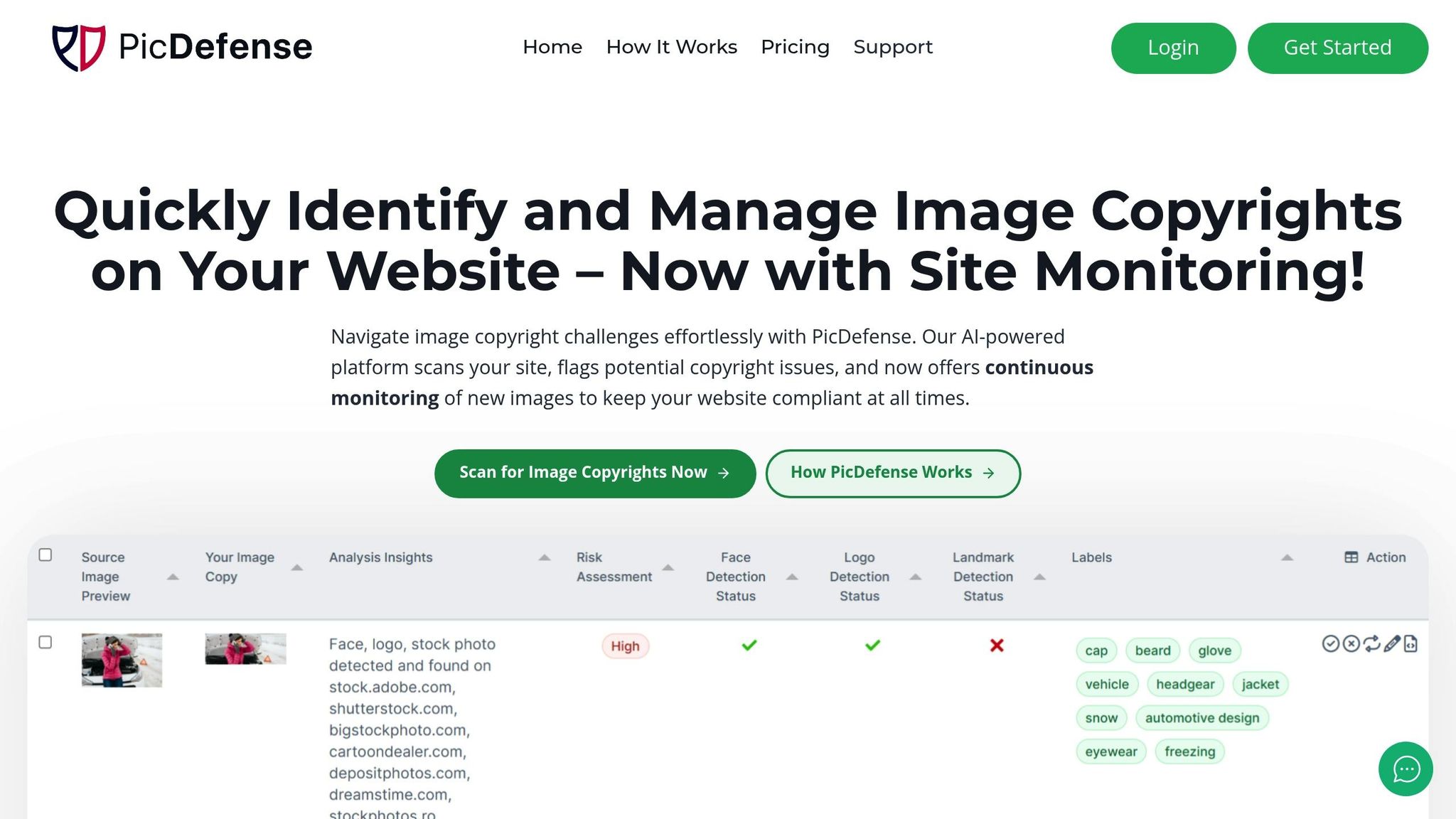
PicDefense uses AI to check websites, make full lists of images, and look at each for copyright spots that might cause trouble. By looking at EXIF info, seeing key features in pictures, and using tools like TinEye and Google Vision to look back at where images came from, the system points out which ones might bring up copyright issues. It even points out where these pictures might have come from with link checks, giving shops a first step to make sure they have the right to use them.
What makes PicDefense stand out from simple scan tools is its job as a main spot for keeping license info. Shops can put and save critical data like buy slips, license files, who to credit, and buy dates. This part is really useful when facing claims that use archive.org time marks, which some bad players use as proof of copying.
The platform's Smart Rules feature also makes following rules simpler by automatically letting the right images go while looking closely at those that need more check. This automatic help cuts down the hard work needed to keep things right on many websites, making sure shops stay on top of possible claims.
Wins of Tidy Compliance
More than finding problems, keeping things neat and ready for checks brings many good points. When demands come in, shops with good records can answer fast and with sure steps instead of looking for proof of the right to use images.
The time saved is big. Instead of digging through old emails and bills, shops can pull up full license info in no time. This clean way is priceless not just for answering claims but also for regular legal checks or when clients need to see proof of correct image use.
Having clear, strong records is key when dealing with copyright trolls. These groups often go after shops they think aren't ready. Full details of buy dates, license terms, and who to credit can stop pointless claims or give a solid defense if legal steps are needed. This smart plan cuts legal dangers while also helping keep money safe with copyright insurance.
For groups or shops that handle many websites, having all compliance managed in one spot is way easier than tracking licenses by hand across different jobs. PicDefense deals with lots at once and can handle endless websites under one account, making it a growing tool for shops getting bigger.
Costs and How to Mix It In
PicDefense has different price ways, with one-time scan credits and monthly setups. The credits start at $20 for 100 pictures (that's $0.20 for each) and go up to $7,000 for 100,000 pictures ($0.07 for each).
For steady checks, monthly setups give more for the money. The Starter Plan, at $30 a month, looks after 3 sites and includes 150 pictures. The Pro Plan, at $75 a month, helps 8 sites and 500 pictures, making it liked by small shops. For bigger needs, the Agency Plan takes care of up to 20 sites with 1,200 pictures for $150 a month.
| Plan Name | Each Month | Number of Sites | Number of Images | Cost for More Images |
|---|---|---|---|---|
| Starter | $30 | 3 sites | 150 pictures | $0.15 per picture |
| Pro | $75 | 8 sites | 500 pictures | $0.14 per picture |
| Agency | $150 | 20 sites | 1,200 pictures | $0.13 per picture |
PicDefense fits well with WordPress through its own plugin, letting it scan and watch WordPress sites on its own. For businesses using other platforms, API access by Zapier and Make.com makes it easy to mix into current work flows. This lets check-ups be easy and part of normal website care. New images are scanned by themselves, and users get told if something is missing or if there are risks.
When you look at the possible cost of one copyright claim - which could be $3,000 to $150,000 per image - even the priciest monthly plan seems worth the money. Having things well ordered and taking care of risks early helps businesses steer clear of the mess and worry that often come with surprise demand notes.
Conclusion
Small shops face big risks with copyright that normal insurance does not cover. Usual plans do not pay when people say you copied them, so there is a gap. Media liability insurance fills this gap but only when the copy was not on purpose.
The cost of fighting these claims is no joke. Just looking into the claim can cost about $250,000, and big fights may go up to over $3.9 million for each side.
Since insurance only helps if the copy was by accident, it is key to focus on following the rules. A good plan mixes media liability insurance with steps to stop risks, which might also make insurance cost less.
To beat these challenges, look at your own risks. Think about what type of work you do, what you use, and your chance of facing claims. This check will guide you to the right blend of insurance and rule-following steps.
By using both insurance and staying ahead on compliance, you can cut down on both the chance of problems and the cost if claims happen. Insurance offers money help, but following rules is your main guard.
Start now - look at your copyright risks, get the right insurance, and set up rule-following steps. Keep in mind, it's cheaper to stop problems than to fight in court.
FAQs
Why do small businesses need copyright insurance, and what risks does it protect against that general business insurance doesn’t?
Small businesses should consider copyright insurance because it offers essential protection against claims of copyright infringement - something that general business insurance policies usually don’t cover. These claims can stem from the unapproved use of copyrighted materials like photos, videos, or written content, which are often used in marketing or online content.
Without this coverage, businesses could face steep legal costs, statutory damages that may reach $150,000 per work for willful infringement, and potential damage to their reputation. Copyright insurance acts as a financial and reputational safeguard, offering much-needed security in today’s content-heavy business environment.
How is media liability insurance different from general and professional liability insurance when it comes to copyright coverage?
Media liability insurance offers protection for businesses against risks associated with media content, such as copyright infringement. While general liability insurance usually covers physical injuries or property damage, and professional liability insurance focuses on errors or negligence in professional services, media liability insurance zeroes in on claims linked to the creation and distribution of content like articles, videos, images, or advertisements.
This coverage is especially crucial for businesses that frequently produce or share media, as it shields them from potential legal and financial challenges tied to intellectual property conflicts, defamation claims, and related concerns.
What steps can small businesses take to follow copyright laws and avoid potential claims, aside from getting copyright insurance?
Small businesses can avoid copyright issues by sticking to content they've created or ensuring they have proper licenses for any third-party material. If you plan to use content from others, always get written permission and double-check that you're following the licensing terms. For added protection, registering original works with the U.S. Copyright Office can serve as solid proof of ownership.
Another smart move is to establish clear internal policies and train employees on copyright compliance. Regularly reviewing your content to confirm it's being used correctly and staying updated on copyright laws can go a long way in preventing accidental violations.
Protect your website from image copyright claims
PicDefense scans your entire website, identifies image risks, and stores proof of compliance — so you never get caught off guard.