Copyright fines in the U.S. depend on the number of infringed works, the intent behind the violation, and how the content is used. Here’s a quick breakdown:
- Standard fines: $750–$30,000 per work.
- Willful violations: Up to $150,000 per work (intentional misconduct).
- Innocent violations: As low as $200 per work (lack of awareness).
Key factors influencing fines:
- Intent: Willful infringements face harsher penalties than accidental or innocent ones.
- Usage purpose: Commercial use typically incurs higher fines than non-commercial use.
- Number of works: Each infringed work adds to the total fine.
Courts use the U.S. Copyright Act (17 U.S.C. § 504) to determine penalties, offering two remedies:
- Statutory damages: Fixed amounts, ideal when financial losses are hard to calculate.
- Actual damages: Based on proven financial harm and any profits earned by the violator.
To avoid fines, businesses should secure proper licenses, conduct regular audits, and use compliance tools like PicDefense.io to monitor content.
How Much Can You Sue For Copyright Infringement? - CountyOffice.org
Legal Framework for Copyright Fine Calculations
The U.S. Copyright Act (17 U.S.C. § 504) provides the foundation for determining penalties in copyright infringement cases within the United States. This federal law lays out clear guidelines for courts when calculating monetary damages, offering two main remedies: statutory damages or actual damages plus profits. Copyright owners can select the option that aligns best with the circumstances of the case [2].
Statutory Damages vs. Actual Damages
Statutory damages are fixed amounts set by law, designed to address situations where actual financial losses are difficult to measure. These damages serve multiple purposes: compensating copyright holders, discouraging future violations, and simplifying the litigation process [4].
In contrast, actual damages reflect the tangible financial losses suffered by the copyright owner, combined with any profits the infringer gained from the unauthorized use. According to a House report, these damages aim to both compensate for losses and prevent infringers from benefiting financially from their actions [2].
Statutory damages are particularly helpful for individual creators or small businesses, as they eliminate the need to prove exact financial harm, which can often be challenging.
Statutory Fine Ranges
The Copyright Act specifies monetary ranges for statutory damages, allowing courts some discretion to adjust awards based on factors like intent and the number of works infringed. The following table outlines these ranges:
| Type of Infringement | Statutory Damage Range (per work) | Key Considerations |
|---|---|---|
| Standard Infringement | $750 – $30,000 | Default range for most violations |
| Willful Infringement | Up to $150,000 | Requires proof of intentional violation |
| Innocent Infringement | As low as $200 | Infringer must prove lack of awareness |
For willful infringement, courts can impose fines of up to $150,000 per work if the copyright owner demonstrates intentional misconduct [4]. On the other hand, cases of innocent infringement - where the infringer can show they were unaware of the violation - may result in reduced damages as low as $200 per work [4].
These fines apply on a per-work basis, meaning that infringing on multiple works can lead to significantly higher total damages. Courts may also include costs and attorney's fees in their assessments, further increasing the financial consequences for infringers [6].
Factors That Determine Fine Amounts
Building on the legal framework, courts consider several factors when calculating fine amounts. These elements help explain why some copyright infringement cases result in minor penalties while others lead to hefty financial consequences.
Number of Works Infringed
Each copyrighted work carries its own penalty, meaning that infringing on multiple works can quickly escalate the financial stakes.
Under U.S. copyright law, a copyright owner can receive only one statutory damage award per work, regardless of the number of violations[7]. However, courts still factor in repeated violations of the same work when determining damages. For instance, infringing on five separate photographs could lead to cumulative fines ranging from $3,750 to $150,000.
Courts also weigh the need to deter future violations. A business infringing on dozens of works may face harsher penalties per work compared to someone who unknowingly used a single image. The intent behind the infringement - whether deliberate or accidental - further influences the final fine.
Intent: Willful vs. Unintentional Infringement
Intent plays a critical role in how fines are determined. The law differentiates between willful and unintentional violations, with each category carrying different consequences.
Willful infringement, where the violator knowingly breaks copyright laws, can result in fines as high as $150,000 per work[8]. Courts treat these cases most stringently, especially when there’s evidence of deliberate intent or financial gain.
Unintentional infringement applies to cases where the violator lacked malicious intent. In these situations, statutory damages range from $750 to $30,000 per work[9]. For innocent infringement - where the violator reasonably believed their use was allowed - damages can be reduced to as little as $200 per work[9][3].
Here’s a quick breakdown of fine ranges based on intent:
| Type of Infringement | Statutory Damages Range (per work) | Key Considerations |
|---|---|---|
| Willful | Up to $150,000 | Intent to infringe, potential financial gain |
| Unintentional | $750 to $30,000 | Lack of intent, attempts to comply with copyright law |
| Innocent | As low as $200 | Reasonable belief of permissible use, lack of knowledge |
Commercial vs. Non-Commercial Use
The purpose behind the infringement also heavily influences fines. Courts treat commercial violations more seriously than non-commercial ones, often imposing higher penalties.
Commercial use involves exploiting copyrighted material for financial gain, such as using protected images in advertisements, selling products with copyrighted elements, or incorporating copyrighted music into promotional content. Non-commercial use, on the other hand, might involve personal or educational purposes, like using a copyrighted image on a personal blog or in a classroom presentation.
This distinction matters because commercial infringements are seen as more damaging, often likened to professional misconduct. For example, corporations engaging in commercial infringement may face fines up to $585,000[10], while individuals might be fined up to $150,000[10]. Additionally, willful infringement for financial gain can lead to criminal penalties, including fines of up to $250,000 and up to five years in prison[11].
David Siegel, a legal expert, captures this sentiment:
"In a sense, there is no difference, the law is the same. But when the infringement is for a commercial purpose, the copyright owner is more likely to sue, and the court may well award higher damages."[10]
These factors - volume, intent, and purpose - work together to guide courts in determining fines that match the scale and nature of the infringement.
sbb-itb-59d21f2
How to Calculate Copyright Fines: Step-by-Step Process
Knowing how copyright fines are calculated can help website owners better understand their potential liability and make smarter decisions about their content. While each case is different, courts generally follow a structured process to determine penalties.
Step 1: Count the Number of Infringed Works
Start by identifying every instance where copyrighted works are used without permission. Each unauthorized use is treated as a separate infringement, meaning that using five copyrighted images without approval could lead to five individual claims - each with its own potential fine.
Conduct a thorough audit of your website to spot any copyright risks. This includes reviewing text, images, videos, music, and software for unauthorized use [1][14]. As the U.S. Copyright Office states:
"If you use a copyrighted work without authorization, the owner may be entitled to bring an infringement action against you." [13]
To ensure accuracy, compare your website's content with the original sources to identify unauthorized copies or adaptations [15]. Keep detailed records of licenses and permissions for all copyrighted materials you use [14]. If you're unsure about the legitimacy of any content, consult the Copyright Office [12].
This step is especially important for websites with large image galleries or extensive product listings, as each unauthorized item could result in its own fine. Once you’ve tallied the infringed works, move on to determining the type of damages.
Step 2: Choose the Type of Damages
The next step is to figure out whether actual damages or statutory damages apply. Actual damages cover proven financial losses, while statutory damages use fixed monetary ranges when financial harm is harder to measure. Statutory damages typically range from $750 to $30,000 per infringement in non-willful cases, but for willful violations, they can go up to $150,000 per work.
Copyright owners must choose between actual damages or statutory damages - they can't claim both [5].
- Actual damages reflect measurable financial losses, such as lost sales or licensing revenue [5]. These damages require proof of economic harm, which could include diminished market value or harm to reputation. If a direct link is established, the infringer’s profits may also be claimed [4].
- Statutory damages are predetermined amounts set by law and are often used when actual losses are difficult to prove [5]. However, these damages are only available if the copyrighted work was registered with the U.S. Copyright Office before the infringement occurred or within three months of its publication [5].
Richard Stim highlights the simplicity of statutory damages:
"In short, statutory damages provide a clearly defined remedy for victims of infringement without the murkiness and uncertainty of the first two categories of damages." [5]
For many website owners, statutory damages offer a clearer understanding of potential fines, as they don’t require detailed financial evidence. In some cases, innocent infringers may face fines as low as $200 [5][4].
Step 3: Assess Intent and Usage Context
The final step involves evaluating the intent behind the infringement and the context in which the copyrighted material was used. These factors can have a significant impact on the final fine amount.
Intent Assessment
Determine whether the infringement was willful or accidental. Willful violations - such as continuing to use copyrighted material after being notified or using it for profit - can lead to fines as high as $150,000 per work. On the other hand, unintentional infringements, where the user reasonably believed the use was allowed, may result in fines as low as $200 per infringement.
The Copyright Act addresses this specifically:
"in a case where the infringer sustains the burden of proving, and the court finds, that such infringer was not aware and had no reason to believe that his or her acts constituted an infringement of copyright, the court in its discretion may reduce the award of statutory damages to a sum of not less than $200." [16]
Usage Context
Courts also take into account whether the infringement was for commercial or non-commercial purposes. Commercial use, which involves profiting from copyrighted material, generally results in higher fines. Non-commercial use, like personal or educational purposes, may lead to reduced penalties.
Demonstrating Good Faith
Website owners can potentially lower penalties by showing good faith efforts. For example, promptly responding to a cease and desist notice and correcting mistakes can help demonstrate accountability, which might result in more lenient outcomes [9]. Implementing effective content management systems and licensing practices also shows a commitment to preventing future issues [9].
How to Avoid Copyright Fines
Taking proactive steps to manage copyright risks can save businesses from hefty fines and potential legal troubles. By addressing these issues upfront, companies can avoid unnecessary costs and reduce the chances of litigation.
For digital businesses, automating compliance checks is a practical and efficient way to sidestep copyright violations. Always secure explicit permission before using someone else’s work. This could mean obtaining written agreements from content creators, using properly licensed images, or creating original content. If you outsource content creation, ensure ownership is transferred to your business through written contracts [17].
As intellectual property lawyer Yasmine Salem Hamdan advises:
"If you see it online and you're like, 'Oh my gosh, I wanna use that in my course. I wanna put that on a t-shirt. I wanna use it on my website,' make sure you have a proper license to use it." [17]
A thorough content audit system is another essential tool for spotting risks early. Regularly review all images, text, videos, and other materials on your website to confirm they are properly licensed. If you find unauthorized content, remove it immediately and investigate any copyright claims promptly [18].
Using PicDefense.io for Risk Management
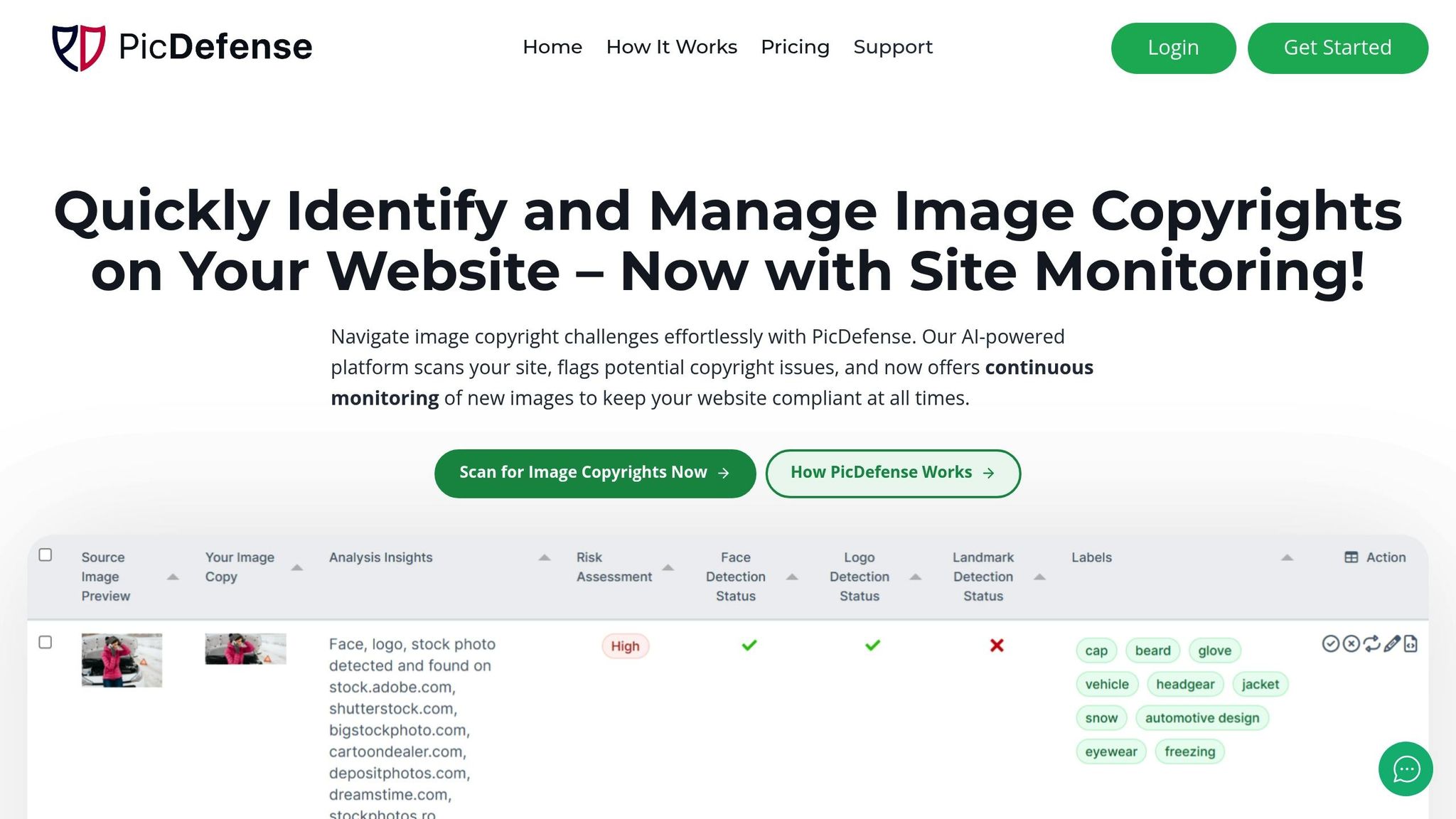
For businesses managing large image libraries, manually checking for copyright compliance can be tedious and prone to mistakes. PicDefense.io simplifies this process by automating image copyright analysis across entire websites, identifying risks before they escalate into legal issues.
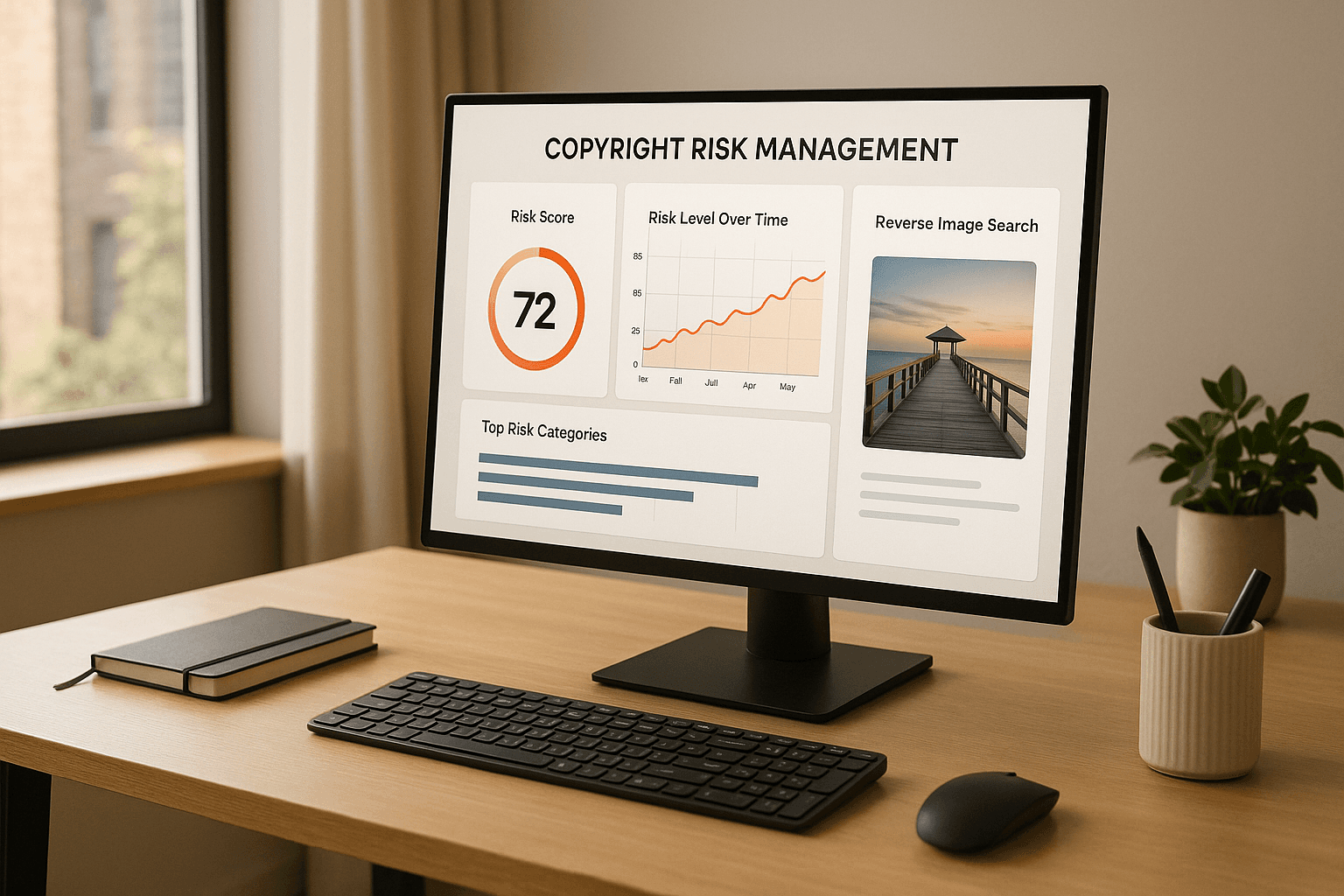
PicDefense.io utilizes advanced scanning technology to create a complete list of images on your site. It compares these images against a database of 73 billion images to detect potential copyright violations. The platform goes further by analyzing EXIF metadata, identifying faces, logos, and landmarks, and even recognizing modified or cropped images. Reverse image search integration helps track where images are used online and pinpoints their sources, including stock image platforms [19].
When issues are detected, PicDefense.io flags them and offers actionable solutions. For example, it might recommend alternative images from platforms like Pexels to replace problematic content. Each analysis includes a risk score, helping you prioritize which images need immediate attention.
For ongoing protection, PicDefense.io offers a Site Monitoring service at $30 per month. This service scans your site weekly, analyzing up to 150 images per month, with unused credits rolling over. This ensures that newly added content is regularly checked for compliance [19].
Benefits of Automated Compliance Tools
Automated tools like PicDefense.io bring major advantages for businesses handling large volumes of visual content. They save time by scanning entire websites in minutes and generating detailed reports that highlight potential copyright issues, eliminating the need for time-consuming manual reviews.
By catching copyright concerns early, these tools can help businesses avoid costly legal disputes. Features like a whitelist function allow users to mark approved images, streamlining future audits. Additionally, the platform lets you document licensing information, creating a reliable compliance record that demonstrates your commitment to copyright laws [19].
PicDefense.io supports multiple image formats, including JPEG, PNG, WEBP, and GIF, ensuring comprehensive coverage for your website [19]. It also integrates seamlessly with WordPress through a plugin, offers API access for custom workflows, and connects with automation tools like Zapier and Make.com [19].
Flexible pricing options make PicDefense.io accessible for businesses of all sizes. Single scans start at $20 for 100 credits, while the ongoing Site Monitoring service costs $30 per month. Additional scans are available at $0.15 each. The platform also prioritizes user privacy with features like end-to-end encryption, strict access controls, and a no-storage policy for analyzed images [19].
These automated tools fit effortlessly into existing workflows, providing businesses with the insights they need to make informed decisions about image usage and maintain compliance with copyright laws. By addressing risks early, companies can focus on their growth without worrying about potential legal setbacks.
Conclusion
Understanding how copyright fines are determined is crucial for protecting your business from hefty legal and financial penalties. In the United States, statutory damages for copyright infringement typically range from $750 to $30,000 per work. However, fines can skyrocket to $150,000 per work for willful infringement. For example, Joel Tenenbaum, a former Boston University student, faced a staggering $675,000 fine for illegally downloading and sharing just 30 songs. This case highlights how quickly liabilities can escalate.
Familiarity with copyright laws allows businesses to take proactive steps, such as assessing the number of infringed works, evaluating intent, and understanding how the content is used. These factors are essential for making informed decisions regarding content usage and licensing. Additionally, understanding defenses like fair use can help mitigate penalties in cases of accidental infringement [9].
Proactive risk management is key, especially for businesses handling large volumes of digital content. Tools like PicDefense.io can streamline compliance by scanning websites, analyzing images, and identifying potential copyright issues. This automated approach helps reduce risks and ensures businesses remain compliant, minimizing the likelihood of costly legal battles.
To avoid copyright fines, businesses should prioritize preventive measures such as regular audits, staff training, proper licensing, and automated monitoring [20]. By adopting these strategies, companies can shift their focus to growth and innovation without the constant worry of legal complications.
FAQs
How do businesses decide between statutory damages and actual damages in copyright infringement cases?
When addressing copyright infringement, businesses often choose between statutory damages and actual damages, depending on the case and the evidence at hand.
Statutory damages range from $750 to $30,000 per infringement, and in cases of willful violations, they can climb to $150,000. These are typically favored when proving specific financial losses is difficult, as they don't require detailed evidence of harm.
In contrast, actual damages focus on the tangible financial effects of the infringement, such as lost profits or unpaid licensing fees. To pursue this route, businesses must present clear and detailed proof of these losses. The choice between the two approaches hinges on the quality of the evidence and the specifics of the infringement case.
How can individuals or businesses prove unintentional copyright infringement to reduce fines?
To potentially reduce fines for copyright infringement, it's crucial to demonstrate that the violation was unintentional. This means providing evidence that you genuinely believed your use of the material was lawful. Courts may reduce statutory damages to as low as $200 per work if the infringement is deemed innocent.
To support your case, consider these actions:
- Document your efforts to verify copyright permissions.
- Show how you adhered to fair use guidelines.
- Provide proof that the infringement was accidental.
Using tools like AI-powered platforms to manage copyright risks can also reflect your good faith and diligence in preventing violations. Taking these steps can make a strong case for leniency.
How does using copyrighted material for commercial or non-commercial purposes affect the fines for infringement?
The penalties for copyright infringement largely hinge on whether the material was used for commercial or non-commercial purposes. When the use is commercial, the fines are typically steeper since it can directly cut into the copyright owner's earnings and is often treated as intentional infringement. On the other hand, non-commercial use, though still punishable, is generally seen as less damaging and may result in lighter penalties.
Courts weigh several factors when determining fines, including the infringer's intent, the extent of the infringement, and the financial harm caused to the copyright owner. To avoid these risks, it’s essential to secure the proper licenses or usage rights for any copyrighted material, particularly when it’s intended for business use.
Protect your website from image copyright claims
PicDefense scans your entire website, identifies image risks, and stores proof of compliance — so you never get caught off guard.